
• KARM
  • Contact us
  • E-Submission
ABOUT
ARTICLE TYPES
BROWSE ARTICLES
AUTHOR INFORMATION

Articles

Original Article

Correlation of Serum Creatine Kinase Level With Pulmonary Function in Duchenne Muscular Dystrophy

Eun Young Kim, MD1,2orcid, Jang Woo Lee, MD3orcid, Mi Ri Suh, MD1,2orcid, Won Ah Choi, MD, PhD1,2orcid, Seong Woong Kang, MD, PhD1,2orcid, Hyeon Jun Oh, MD1,2orcid
Annals of Rehabilitation Medicine 2017;41(2):306-312.
Published online: April 27, 2017

1Department of Rehabilitation Medicine, Gangnam Severance Hospital, Seoul, Korea.

2Rehabilitation Institute of Neuromuscular Disease, Yonsei University College of Medicine, Seoul, Korea.

3Department of Rehabilitation Medicine, Chuncheon Sacred Heart Hospital, Chuncheon, Korea.

Corresponding author: Hyeon Jun Oh. Department of Rehabilitation Medicine, Gangnam Severance Hospital, 211 Eonju-ro, Gangnam-gu, Seoul 06273, Korea. Tel: +82-2-2019-2640, Fax: +82-2-3462-0119, sposta@yuhs.ac
• Received: April 4, 2016   • Accepted: July 6, 2016

Copyright © 2017 by Korean Academy of Rehabilitation Medicine

This is an open-access article distributed under the terms of the Creative Commons Attribution Non-Commercial License (http://creativecommons.org/licenses/by-nc/4.0) which permits unrestricted noncommercial use, distribution, and reproduction in any medium, provided the original work is properly cited.

  • 17,994 Views
  • 115 Download
  • 24 Web of Science
  • 24 Crossref
  • 21 Scopus
prev next
  • Objective
    To investigate the relationship between serum creatine kinase (CK) level and pulmonary function in Duchenne muscular dystrophy (DMD).
  • Methods
    A total of 202 patients with DMD admitted to the Department of Rehabilitation Medicine, Gangnam Severance Hospital were enrolled from January 1, 1999 to March 31, 2015. Seventeen patients were excluded. Data collected from the 185 patients included age, height, weight, body mass index, pulmonary function tests including forced vital capacity (FVC), peak cough flow, maximal expiratory pressure (MEP), and maximal inspiratory pressure (MIP), and laboratory measurements (serum level of CK, CK-MB, troponin-T, and B-type natriuretic peptide). FVC, MEP, and MIP were expressed as percentages of predicted normal values.
  • Results
    Serum CK activities were elevated above normal levels, even in the oldest DMD group. Serum CK level was strongly correlated with pulmonary functions of sitting FVC (p<0.001), supine FVC (p<0.001), MIP (p=0.004), and MEP (p<0.001).
  • Conclusion
    Serum CK level is a reliable screening test even in patients with advanced DMD, and is a strong predictor of pulmonary functions.
Duchenne muscular dystrophy (DMD) is an X-linked recessive inherited, neuromuscular disorder affecting one in 4,700 live male births [1]. It is characterized by progressive and severe muscle deterioration resulting from a lack of dystrophin, which provides structural stability to the muscle cell membrane [2].
The increased permeability of the sarcolemma leads to the release of creatine kinase (CK) from muscle fibers. Therefore, an increased level of serum CK is the hallmark of muscle damage. In patients with DMD, CK is markedly elevated compared with the normal range, which has diagnostic value. Furthermore, maximum serum CK activity is usually observed from 2 to 5 years of age in DMD, and progressively decreases as the disease progresses [3]. The decreasing rate of serum CK level has a stronger correlation with the progression of the dystrophic process than age [3].
Most patients with DMD die from respiratory failure and its resulting complications. Abundant research indicates that pulmonary functions in patients with DMD monotonically decline as they grow older due to dystrophic changes that occur in the respiratory musculature [4567]. However, whether the serum CK level can reflect pulmonary function is unknown.
The aim of this study was to investigate serum CK variability with age in a large group of patients with DMD, and to determine the relationship between serum CK level and pulmonary function in DMD.
Subjects
The study was conducted on the patients with DMD who were admitted to Gangnam Severance Hospital and had pulmonary function tests performed from January 1, 1999 to March 31, 2015. The majority of these patients had been monitored for many years. The diagnosis was made on the basis of clinical evaluation with genetic study or muscle biopsy. The exclusion criteria were patients whose clinical condition was not good enough to measure exact pulmonary function due to medical problems, and lack of testing for routine blood chemistry, including serum CK level. A retrospective analysis of the medical records of the patients was conducted.
Methods
Anthropometric variables including body weight (kg) and height (cm), were measured. Body mass index (BMI, kg/m2) was calculated as body weight divided by the square of height. Serum levels of CK (normal range, 35–232 U/L), CK-MB (normal range, 0–6.73 µg/L), troponin-T (Tn-T; normal range, 0.003–0.014 µg/L), and B-type natriuretic peptide (BNP; normal range, 0–100 pg/mL) were measured on the day of admission.
Pulmonary functions including respiratory muscle strength were evaluated by two physicians or a physician and research physical therapist. Forced vital capacity (FVC) was measured in the sitting and supine positions using a hand-held spirometer (Micro Spirometer; Micro Medical Ltd., Rochester, Kent, UK). Peak cough flow (PCF) was measured using an Assess Peak Flow Meter (Philips Respironics, Guildford, UK). The highest values of FVC and PCF were selected from at least three attempts. Maximal expiratory pressure (MEP) and maximal inspiratory pressure (MIP), reflecting the strength of respiratory muscles, were measured by a MicroRPM respiratory pressure meter (Micro Medical Ltd.) in the sitting position. Maximal values for MEP and MIP were selected from at least three attempts. FVC, MEP, and MIP were expressed as percentages of predicted normal values [8910].
Statistical analyses
Statistical evaluations were assessed using IBM SPSS Statistics ver. 20 (IBM, Armonk, NY, USA). The descriptive statistics are presented with mean±standard deviation (SD) and range for all parameters. Because this study is based on the assumption that serum CK level reflects respiratory muscle degeneration, advanced statistical analysis was conducted only for the serum CK level, except for the other variables. Pearson correlation coefficients were calculated to assess possible linear relationships between the respiratory variables and serum CK level. Simple linear regression analysis was performed to identify the influence of clinical parameters, including serum CK level, on the respiratory parameters, the dependent variables. Subsequently, to identify parameters that significantly contributed to pulmonary function, the variables of p<0.05 by simple regression analysis were included in multiple regression analysis. Due to the multicollinearity of weight, height, and BMI, only height was included in the model. All tests were two-sided and p<0.05 was considered statistically significant.
During the study period, 202 patients with DMD were admitted to Gangnam Severance Hospital, and the total number of repeated admission episodes was 805. Forty-five episodes when the patients' clinical conditions were not good enough to measure exact pulmonary function were excluded (these included pneumonia in 26 patients, upper respiratory infection in 7 patients, pleural effusion in 2 patients, bronchitis in 1 patient, pneumothorax in 1 patient, mandible fracture in 1 patient, airway obstruction in 2 patients, acute pulmonary tuberculosis in 1 patient, and tracheostomy tube insertion status in 4 patients). In addition, 112 episodes when the patients were not tested for routine blood chemistry, including serum CK level, were excluded, as were 83 episodes of patients whose medical records were missing. The remaining 185 patients (565 repeated episodes) were included for data analysis (Fig. 1). For statistical analysis, only the first admission episode was used in this study.
Serum CK variability with age
The mean age of 185 patients was 18.8±5.3 years (evenly distributed age of 7.8–35.3 years). The mean BMI was 17.0±5.0 kg/m2. The mean serum CK level was 1,547.9±1,646.2 U/L (Table 1). Furthermore, serum CK level progressively decreased with age. However, serum CK activities were elevated above normal even in the oldest group. Moreover, the serum CK level was maximally elevated to a level 46.7 times higher than the normal value (Fig. 2). The rate of decrease per year for serum CK level transformed by Napierian logarithm value was 10%. The mean serum levels of CK-MB and Tn-T were elevated above normal, and the mean BNP level was within normal range.
Relationship between serum CK level and pulmonary functions
Mean±SD values of respiratory parameters were as follows: sitting FVC, 935.3±614.7 mL and 29.0%±23.0%; supine FVC, 898.0±578.3 mL and 27.6%±22.0%; PCF, 164.8±62.7 m/s; MIP, 24.0±16.0 cmH2O and 27.4%±20.7%; and MEP, 22.8±13.4 cmH2O and 18.1%±13.5%. The clinical parameters of the patients are summarized in Table 1.
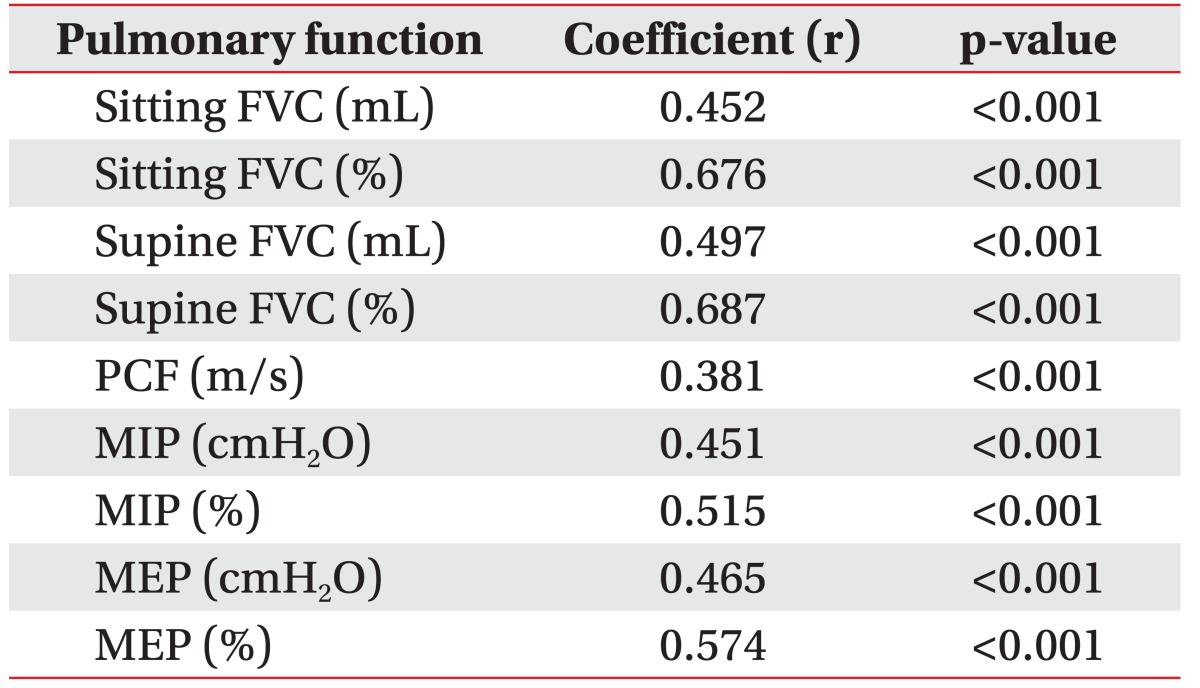
Serum CK level and all respiratory parameters were significantly correlated. This was particularly true for sitting FVC (%), supine FVC (%), MIP (%), and MEP (%) where there was strong positive relationship demonstrated by Pearson correlation coefficient values of 0.676 (p<0.001), 0.687 (p<0.001), 0.515 (p<0.001), and 0.574 (p<0.001), respectively (Table 2).
A multivariate regression model was used to identify the combination of variables that best predicted respiratory variables of interest. Prior to that, simple regression analysis was conducted to choose the variables using a multivariate regression model. Simple linear regression analysis showed that many variables were associated with sitting and supine FVC (%): age, height, BMI, Tn-T, CK, and CK-MB. A multivariate regression model was built using age, height, BMI, Tn-T, and CK as potential predictors. Because of a strong linear correlation with CK (Pearson coefficient=0.920, p<0.001), CK-MB was excluded from the multivariate regression model. Strong correlation was observed for CK, age, and BMI, followed by height (Tables 3, 4).
In DMD serum CK is extremely elevated (10–100 times the normal level since birth), and the maximum activities of serum CK are observed from 2 to 5 years of age [3]. Consistent with this, we observed maximally elevated serum CK levels at 46.7 times higher than the normal levels. Furthermore, we observed the serum CK levels from 7.8 to 35.3 years of age in these patients. This is important because clinical parameters of patients with DMD aged over 20 years, and particularly over 30, are rarely reported. The Napierian logarithm value of serum CK level was used to assess the rate of decrease per year for serum CK for comparison with previous results [3]. The rate of decrease per year for serum CK level was 10%, which is lower than 18% [3] and 20% [3]. This may be due to the overall increase in life expectancy of patients that benefited from the advances in therapies including noninvasive ventilators.
The main finding from our study is that the serum CK levels were strongly correlated with FVC (%), MIP (%), and MEP (%), showing the strongest correlation with FVC (%). Most patients with DMD die from respiratory failure or conditions associated with it. However, pulmonary functions are the only known prognostic markers for patients with DMD [11]. Previous studies have suggested that pulmonary functions monotonically decline with age [4567]. However, other factors other than age that predict pulmonary functions have not been discovered. Furthermore, no studies have revealed a direct relationship between pulmonary function and serum CK in patients with DMD.
Increased serum CK activities reflect muscle degeneration. However, the serum CK level is extremely variable and ranges from normal to a fairly marked elevation; thus, it could be considered that disease severity is not closely associated with the serum CK level. Nevertheless, a few studies have been successful in elucidating the importance of serum CK. A previous study revealed that serum CK level is valuable in discriminating between DMD and other hereditary types of muscular dystrophy, and could be a more sensitive indicator of DMD than other clinical examinations [12]. In addition, declined serum CK level has been more strongly correlated with the Vignos scale age in patients with DMD, where serum CK levels represent the functional level of patients more accurately than their age [3]. The collective results indicate that the Vigno scale and pulmonary functions are correlated.
Interpretation of serum CK levels in patients with DMD could be promising in these aspects. Even though spirometry is a sensitive indicator of residual respiratory muscle function, it is not reliable in poorly cooperative patients and for some medical conditions affecting the lung parenchyma or airway. Considering this, measuring serum CK levels could be an alternative method, directly reflecting the residual respiratory muscle function even in the aforementioned conditions. Moreover, new treatments for dystrophic diseases that focus on restoring dystrophin in the skeletal muscle have been developed recently. Primary outcomes for these studies were dystrophin expression, motility, and life expectancy [13141516]. One study assessed the efficacy of the injection by comparing serum CK levels before and after intravenous gentamicin in boys with a nonsense mutation. Serum CK level declined with the use of the drug, indicating efficacy [16]. Serum CK could be an inexpensive, simple, and strong indicator assessing the success of therapeutic trials, particularly for pulmonary functions.
The limitation of this study is that only first hospitalization episodes were analyzed and used for the purpose of statistical applications. Further studies that focus on the parameter changes in each patient are required.
In conclusion, the serum CK activities were elevated above normal even in the oldest DMD group. Therefore, CK is a reliable screening test even in patients with advanced DMD. Serum CK was linearly associated with sitting and supine FVC (%), MIP (%), and MEP (%) in patients with DMD. Thus, serum CK is a strong predictor for pulmonary function in patients with DMD. Further studies are needed to clarify whether serum CK has an impact on pulmonary function so that pharmacological and newly developed genetic interventions can be assessed.

CONFLICT OF INTEREST: No potential conflict of interest relevant to this article was reported.

  • 1. Helderman-van den Enden AT, Madan K, Breuning MH, van der Hout AH, Bakker E, de Die-Smulders CE, et al. An urgent need for a change in policy revealed by a study on prenatal testing for Duchenne muscular dystrophy. Eur J Hum Genet 2013;21:21-26.
  • 2. Deconinck N, Dan B. Pathophysiology of Duchenne muscular dystrophy: current hypotheses. Pediatr Neurol 2007;36:1-7.
  • 3. Zatz M, Rapaport D, Vainzof M, Passos-Bueno MR, Bortolini ER, Pavanello Rde C, et al. Serum creatine-kinase (CK) and pyruvate-kinase (PK) activities in Duchenne (DMD) as compared with Becker (BMD) muscular dystrophy. J Neurol Sci 1991;102:190-196.
  • 4. Inkley SR, Oldenburg FC, Vignos PJ Jr. Pulmonary function in Duchenne muscular dystrophy related to stage of disease. Am J Med 1974;56:297-306.
  • 5. Hapke EJ, Meek JC, Jacobs J. Pulmonary function in progressive muscular dystrophy. Chest 1972;61:41-47.
  • 6. Rideau Y, Jankowski LW, Grellet J. Respiratory function in the muscular dystrophies. Muscle Nerve 1981;4:155-164.
  • 7. Hahn A, Bach JR, Delaubier A, Renardel-Irani A, Guillou C, Rideau Y. Clinical implications of maximal respiratory pressure determinations for individuals with Duchenne muscular dystrophy. Arch Phys Med Rehabil 1997;78:1-6.
  • 8. Morris JF, Koski A, Johnson LC. Spirometric standards for healthy nonsmoking adults. Am Rev Respir Dis 1971;103:57-67.
  • 9. Polgar G, Promadhat V. Pulmonary function testing in children: techniques and standards. Philadelphia: Saunders; 1971.
  • 10. Wilson SH, Cooke NT, Edwards RH, Spiro SG. Predicted normal values for maximal respiratory pressures in Caucasian adults and children. Thorax 1984;39:535-538.
  • 11. Phillips MF, Quinlivan RC, Edwards RH, Calverley PM. Changes in spirometry over time as a prognostic marker in patients with Duchenne muscular dystrophy. Am J Respir Crit Care Med 2001;164:2191-2194.
  • 12. Pearce JM, Pennington RJ, Walton JN. Serum enzyme studies in muscle disease. II: Serum creatine kinase activity in muscular dystrophy and in other myopathic and neuropathic disorders. J Neurol Neurosurg Psychiatry 1964;27:96-99.
  • 13. Haas M, Vlcek V, Balabanov P, Salmonson T, Bakchine S, Markey G, et al. European Medicines Agency review of ataluren for the treatment of ambulant patients aged 5 years and older with Duchenne muscular dystrophy resulting from a nonsense mutation in the dystrophin gene. Neuromuscul Disord 2015;25:5-13.
  • 14. Finkel RS, Flanigan KM, Wong B, Bonnemann C, Sampson J, Sweeney HL, et al. Phase 2a study of ataluren-mediated dystrophin production in patients with nonsense mutation Duchenne muscular dystrophy. PLoS One 2013;8:e81302.
  • 15. Bushby K, Finkel R, Wong B, Barohn R, Campbell C, Comi GP, et al. Ataluren treatment of patients with nonsense mutation dystrophinopathy. Muscle Nerve 2014;50:477-487.
  • 16. Malik V, Rodino-Klapac LR, Viollet L, Wall C, King W, Al-Dahhak R, et al. Gentamicin-induced readthrough of stop codons in Duchenne muscular dystrophy. Ann Neurol 2010;67:771-780.
Fig. 1

Study flow.

arm-41-306-g001.jpg
Fig. 2

Serum creatine kinase (CK) level according to age.

arm-41-306-g002.jpg
Table 1

Baseline characteristics of patients

Values are presented as mean±standard deviation (range). BMI, body mass index; CK, creatine kinase; CK-MB, creatine kinase MB; Tn-T, troponin T; BNP, B-type natriuretic peptide; FVC, forced vital capacity; PCF, peak cough flow; MIP, maximal inspiratory pressure; MEP, maximal expiratory pressure.

arm-41-306-i001.jpg
Table 2

Pearson correlation between serum creatine kinase and pulmonary functions

FVC, forced vital capacity; PCF, peak cough flow; MIP, maximal inspiratory pressure; MEP, maximal expiratory pressure.

arm-41-306-i002.jpg
Table 3

Association between clinical parameters and pulmonary functions (simple regression analysis)

FVC, forced vital capacity; MIP, maximal inspiratory pressure; MEP, maximal expiratory pressure; BMI, body mass index; CK, creatine kinase; CK-MB, creatine kinase MB; Tn-T, troponin T; BNP, B-type natriuretic peptide.

arm-41-306-i003.jpg
Table 4

Association between clinical parameters and pulmonary functions (multiple regression analysis)

FVC, forced vital capacity; MIP, maximal inspiratory pressure; MEP, maximal expiratory pressure; CK, creatine kinase; Tn-T, troponin T.

arm-41-306-i004.jpg

Figure & Data

References

    Citations

    Citations to this article as recorded by  
    • Cardiac and skeletal muscle delivery of biotherapeutics with a blood vessel epicardial substance-targeting peptide
      Biaobiao Wang, Jiahui Cao, Jingqiao Wu, Yiwen Zhao, Yao Zhang, Frank Abendroth, Caorui Lin, Li Zhong, Huanan Yu, Yiqi Seow, Meitong Ou, Olalla Vázquez, Lin Mei, HaiFang Yin, Gang Han
      Biomaterials.2026; 329: 123986.     CrossRef
    • Orthopaedic Management in Duchenne Muscular Dystrophy
      Uma Balachandran, Taylor Mustapich, Sheena C. Ranade
      Journal of the Pediatric Orthopaedic Society of North America.2025; 10: 100154.     CrossRef
    • Fighting for every beat: cardiac therapies in Duchenne muscular dystrophy
      Antoine Muchir
      Skeletal Muscle.2025;[Epub]     CrossRef
    • In Vivo Phage Display for the Identification of Muscle Homing Peptides to Improve the Delivery of Phosphorodiamidate Morpholino Oligomers for Duchenne Muscular Dystrophy Therapy
      Anne-Fleur E. Schneider, Christa L. Tanganyika-de Winter, Hailiang Mei, Silvana M.G. Jirka, Xuyu Tan, Emily G. Thompson, Kristin Ha, Anindita Mitra, Stephanie Garcia, Marleen Luimes, Ryan Oliver, Kathy Y. Morgan, Vincent Guerlavais, Annemieke Aartsma-Rus
      Nucleic Acid Therapeutics.2025; 35(5): 220.     CrossRef
    • Statistical Genetics of DMD Gene Mutations in a Kazakhstan Cohort: MLPA/NGS Variant Validation and Genotype–Phenotype Modelling
      Aizhan Moldakaryzova, Dias Dautov, Saken Khaidarov, Saniya Ossikbayeva, Dilyara Kaidarova
      Genes.2025; 17(1): 20.     CrossRef
    • N-terminal titin fragment: a non-invasive, pharmacodynamic biomarker for microdystrophin efficacy
      Jessica F. Boehler, Kristy J. Brown, Valeria Ricotti, Carl A. Morris
      Skeletal Muscle.2024;[Epub]     CrossRef
    • Personalized and muscle-specific OXPHOS measurement with integrated CrCEST MRI and proton MR spectroscopy
      Ryan R. Armbruster, Dushyant Kumar, Blake Benyard, Paul Jacobs, Aditi Khandavilli, Fang Liu, Ravi Prakash Reddy Nanga, Shana McCormack, Anne R. Cappola, Neil Wilson, Ravinder Reddy
      Nature Communications.2024;[Epub]     CrossRef
    • Synthetic datasets for open software development in rare disease research
      Ibraheem Al-Dhamari, Hammam Abu Attieh, Fabian Prasser
      Orphanet Journal of Rare Diseases.2024;[Epub]     CrossRef
    • Unveiling the Respiratory Muscle Strength in Duchenne Muscular Dystrophy: The Impact of Nutrition and Thoracic Deformities, Beyond Spirometry
      Mine Yuksel Kalyoncu, Yasemin Gokdemir, Cansu Yilmaz Yegit, Muruvvet Yanaz, Aynur Gulieva, Merve Selcuk, Şeyda Karabulut, Neval Metin Çakar, Pinar Ergenekon, Ela Erdem Eralp, Gülten Öztürk, Olcay Unver, Dilsad Turkdogan, Yavuz Sahbat, Ahmet Hamdi Akgülle,
      Children.2024; 11(8): 994.     CrossRef
    • Duchenne Muscular Dystrophy in Two Half-Brothers Due to Inherited 306 Kb Inverted Insertion of 10p15.1 into Intron 44 of the Dp427m Transcript of the DMD Gene
      Wayne M. Jepsen, Andrew Fazenbaker, Keri Ramsey, Anna Bonfitto, Marcus Naymik, Bryce Turner, Jennifer Sloan, Nishant Tiwari, Saunder M. Bernes, Derek E. Neilson, Meredith Sanchez-Castillo, Matt J. Huentelman, Vinodh Narayanan
      International Journal of Molecular Sciences.2024; 25(22): 11922.     CrossRef
    • Chronic granulomatous disease associated with Duchenne muscular dystrophy caused by Xp21.1 contiguous gene deletion syndrome: Case report and literature review
      Shaohua Bi, Liying Dai, Liangliang Jiang, Lili Wang, Mia Teng, Guanghui Liu, Ru-Jeng Teng
      Frontiers in Genetics.2023;[Epub]     CrossRef
    • Urine titin as a novel biomarker for Duchenne muscular dystrophy
      Misawa Niki Ishii, Masato Nakashima, Hidenori Kamiguchi, Neta Zach, Ryosuke Kuboki, Rina Baba, Takeshi Hirakawa, Kazunori Suzuki, Maria Quinton
      Neuromuscular Disorders.2023; 33(4): 302.     CrossRef
    • Creatine Kinase Is Decreased in Childhood Asthma
      Stefano Guerra, Julie G. Ledford, Erik Melén, Iris Lavi, Anne-Elie Carsin, Debra A. Stern, Jing Zhai, Marta Vidal, Mariona Bustamante, Kenneth J. Addison, Renata G. Vallecillo, Dean Billheimer, Gerard H. Koppelman, Judith Garcia-Aymerich, Nathanaël Lemonn
      American Journal of Respiratory and Critical Care Medicine.2023; 207(5): 544.     CrossRef
    • Advances in Dystrophinopathy Diagnosis and Therapy
      Fawzy A. Saad, Gabriele Siciliano, Corrado Angelini
      Biomolecules.2023; 13(9): 1319.     CrossRef
    • MOTS‐c promotes phosphorodiamidate morpholino oligomer uptake and efficacy in dystrophic mice
      Ning Ran, Caorui Lin, Ling Leng, Gang Han, Mengyuan Geng, Yingjie Wu, Scott Bittner, Hong M Moulton, HaiFang Yin
      EMBO Molecular Medicine.2021;[Epub]     CrossRef
    • RESPIRATORY MUSCLE IMPAIRMENT EVALUATED WITH MEP/MIP RATIO IN CHILDREN AND ADOLESCENTS WITH CHRONIC RESPIRATORY DISEASE
      Iván Rodríguez-Núñez, Gerardo Torres, Soledad Luarte-Martinez, Carlos Manterola, Daniel Zenteno
      Revista Paulista de Pediatria.2021;[Epub]     CrossRef
    • A Blood Biomarker for Duchenne Muscular Dystrophy Shows That Oxidation State of Albumin Correlates with Protein Oxidation and Damage in Mdx Muscle
      Basma A. Al-Mshhdani, Miranda D. Grounds, Peter G. Arthur, Jessica R. Terrill
      Antioxidants.2021; 10(8): 1241.     CrossRef
    • High‑dose intravenous immunoglobulins as a therapeutic option in critical illness polyneuropathy accompanying SARS‑CoV‑2 infection: A case‑based review of the literature (Review)
      Adina Stoian, Zoltan Bajko, Smaranda Maier, Roxana Cioflinc, Bianca Grigorescu, Anca Moțățăianu, Laura Bărcuțean, Rodica Balașa, Mircea Stoian
      Experimental and Therapeutic Medicine.2021;[Epub]     CrossRef
    • Intensive Care Unit-Acquired Weakness: Not Just Another Muscle Atrophying Condition
      Heta Lad, Tyler M. Saumur, Margaret S. Herridge, Claudia C. dos Santos, Sunita Mathur, Jane Batt, Penney M. Gilbert
      International Journal of Molecular Sciences.2020; 21(21): 7840.     CrossRef
    • Proteomic serum biomarkers for neuromuscular diseases
      Sandra Murphy, Margit Zweyer, Rustam R. Mundegar, Dieter Swandulla, Kay Ohlendieck
      Expert Review of Proteomics.2018; 15(3): 277.     CrossRef
    • Necroptosis mediates myofibre death in dystrophin-deficient mice
      Jennifer E. Morgan, Alexandre Prola, Virginie Mariot, Veronica Pini, Jinhong Meng, Christophe Hourde, Julie Dumonceaux, Francesco Conti, Frederic Relaix, Francois-Jerôme Authier, Laurent Tiret, Francesco Muntoni, Maximilien Bencze
      Nature Communications.2018;[Epub]     CrossRef
    • LIMB GIRDLE MUSCULAR DYSTROPHY IN EARLY CHILDHOOD- CLINICAL HETEROGENEITY AND CLUE TO EARLY DIAGNOSIS
      Beena Vasanthy, Vijayan Chandrathil Parameswaran Nair
      Journal of Evidence Based Medicine and Healthcare.2018; 5(41): 2907.     CrossRef
    • Immunobiology of Inherited Muscular Dystrophies
      James G. Tidball, Steven S. Welc, Michelle Wehling‐Henricks
      Comprehensive Physiology.2018; 8(4): 1313.     CrossRef
    • Comparative Analysis of Serum Proteins from Patients with Severe and Mild EV‐A71‐induced HFMD using iTRAQ‐Coupled LC‐MS/MS Screening
      Peihu Fan, Wei Chen, Pin Yu, Linlin Bao, Lili Xu, Chuan Qin
      PROTEOMICS – Clinical Applications.2017;[Epub]     CrossRef

    Download Citation

    Download a citation file in RIS format that can be imported by all major citation management software, including EndNote, ProCite, RefWorks, and Reference Manager.

    Format:

    Include:

    Correlation of Serum Creatine Kinase Level With Pulmonary Function in Duchenne Muscular Dystrophy
    Ann Rehabil Med. 2017;41(2):306-312.   Published online April 27, 2017
    Download Citation
    Download a citation file in RIS format that can be imported by all major citation management software, including EndNote, ProCite, RefWorks, and Reference Manager.

    Format:
    • RIS — For EndNote, ProCite, RefWorks, and most other reference management software
    • BibTeX — For JabRef, BibDesk, and other BibTeX-specific software
    Include:
    • Citation for the content below
    Correlation of Serum Creatine Kinase Level With Pulmonary Function in Duchenne Muscular Dystrophy
    Ann Rehabil Med. 2017;41(2):306-312.   Published online April 27, 2017
    Close

    Figure

    • 0
    • 1
    Correlation of Serum Creatine Kinase Level With Pulmonary Function in Duchenne Muscular Dystrophy
    Image Image
    Fig. 1 Study flow.
    Fig. 2 Serum creatine kinase (CK) level according to age.
    Correlation of Serum Creatine Kinase Level With Pulmonary Function in Duchenne Muscular Dystrophy

    Baseline characteristics of patients

    Values are presented as mean±standard deviation (range). BMI, body mass index; CK, creatine kinase; CK-MB, creatine kinase MB; Tn-T, troponin T; BNP, B-type natriuretic peptide; FVC, forced vital capacity; PCF, peak cough flow; MIP, maximal inspiratory pressure; MEP, maximal expiratory pressure.

    Pearson correlation between serum creatine kinase and pulmonary functions

    FVC, forced vital capacity; PCF, peak cough flow; MIP, maximal inspiratory pressure; MEP, maximal expiratory pressure.

    Association between clinical parameters and pulmonary functions (simple regression analysis)

    FVC, forced vital capacity; MIP, maximal inspiratory pressure; MEP, maximal expiratory pressure; BMI, body mass index; CK, creatine kinase; CK-MB, creatine kinase MB; Tn-T, troponin T; BNP, B-type natriuretic peptide.

    Association between clinical parameters and pulmonary functions (multiple regression analysis)

    FVC, forced vital capacity; MIP, maximal inspiratory pressure; MEP, maximal expiratory pressure; CK, creatine kinase; Tn-T, troponin T.

    Table 1 Baseline characteristics of patients

    Values are presented as mean±standard deviation (range). BMI, body mass index; CK, creatine kinase; CK-MB, creatine kinase MB; Tn-T, troponin T; BNP, B-type natriuretic peptide; FVC, forced vital capacity; PCF, peak cough flow; MIP, maximal inspiratory pressure; MEP, maximal expiratory pressure.

    Table 2 Pearson correlation between serum creatine kinase and pulmonary functions

    FVC, forced vital capacity; PCF, peak cough flow; MIP, maximal inspiratory pressure; MEP, maximal expiratory pressure.

    Table 3 Association between clinical parameters and pulmonary functions (simple regression analysis)

    FVC, forced vital capacity; MIP, maximal inspiratory pressure; MEP, maximal expiratory pressure; BMI, body mass index; CK, creatine kinase; CK-MB, creatine kinase MB; Tn-T, troponin T; BNP, B-type natriuretic peptide.

    Table 4 Association between clinical parameters and pulmonary functions (multiple regression analysis)

    FVC, forced vital capacity; MIP, maximal inspiratory pressure; MEP, maximal expiratory pressure; CK, creatine kinase; Tn-T, troponin T.

    TOP