
Department of Rehabilitation Medicine, Bundang Jesaeng General Hospital, Seongnam 463-774, Korea.
Corresponding author: Ga Eun Lee. Department of Rehabilitation Medicine, Dajin Medical Center Bundang Jesaeng General Hospital, 255-2, Seohyeon-dong, Bundang-gu, Seongnam 463-774, Korea. Tel: +82-31-779-0395, Fax: +82-31-779-0635, smart0416@hotmail.com
• Received: April 27, 2010 • Accepted: February 23, 2011
This is an Open Access article distributed under the terms of the Creative Commons Attribution Non-Commercial License (http://creativecommons.org/licenses/by-nc/3.0) which permits unrestricted noncommercial use, distribution, and reproduction in any medium, provided the original work is properly cited.
The objectives of this study were to investigate the causes of plantar heel pain and find differences in the clinical features of plantar fasciitis (PF) and fat pad atrophy (FPA), which are common causes of plantar heel pain, for use in differential diagnosis.
Method
This retrospective study analyzed the medical records of 250 patients with plantar heel pain at the Foot Clinic of Rehabilitation Medicine at Bundang Jesaeng General Hospital from January to September, 2008.
Results
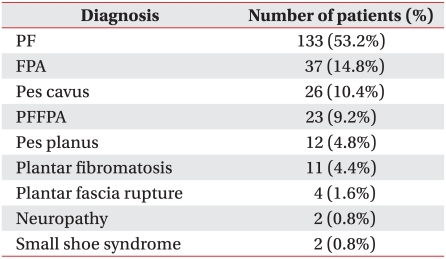
The subjects used in this study were 114 men and 136 women patients with a mean age of 43.8 years and mean heel pain duration of 13.3 months. Causes of plantar heel pain were PF (53.2%), FPA (14.8%), pes cavus (10.4%), PF with FPA (9.2%), pes planus (4.8%), plantar fibromatosis (4.4%), plantar fascia rupture (1.6%), neuropathy (0.8%), and small shoe syndrome (0.8%). PF and FPA were most frequently diagnosed. First-step pain in the morning, and tenderness on medial calcaneal tuberosity correlated with PF. FPA mainly involved bilateral pain, pain at night, and pain that was aggravated by standing. Heel cord tightness was the most common biomechanical abnormality of the foot. Heel spur was frequently seen in X-rays of patients with PF.
Conclusion
Plantar heel pain can be provoked by PF, FPA, and other causes. Patients with PF or FPA typically show different characteristics in clinical features. Plantar heel pain requires differential diagnosis for appropriate treatment.
Plantar heel pain in adulthood is the most common problem of the foot, and can be provoked by bone, soft tissue, nerve, or systemic disease.1,2 Although accurate diagnosis and appropriate management are important, distinguishing the various causes of highly similar symptoms is difficult. Plantar heel pains from skeletal problems are caused by calcaneal stress fracture, apophysitis of the calcaneus (Sever's disease), osteomyelitis, or inflammatory arthropathy. Soft tissue pathology includes fat pad atrophy (FPA) or contusion, plantar fascia rupture and plantar fasciitis (PF). Heel pain may be induced by neural causes such as entrapment or compression of the first branch of the lateral plantar nerve (Baxter's nerve), medial calcaneal branch of posterior tibial nerve, or nerve to abductor digiti quinti muscle. Other neural causes include S1 radiculopathy, tarsal tunnel syndrome, and peripheral neuropathy.1,3
PF is reported to be the most common cause of plantar heel pain.1 The pathology is still unknown, but histopathologic examination of biopsy specimens from patients undergoing excessive extension or microinjuries of the plantar fascia shows secondary degenerative changes in the plantar fascia, with or without fibroblastic proliferation, and without acute inflammation.4 The peak age of incidence in the general population is between 40 and 60 years. The risk factors for PF include running excessively (or suddenly increasing running distance), occupations that involve long periods of standing, pes planus, limited ankle dorsiflexion, and obesity.1,3,5 FPA occurs after 40 years because of atrophy and thinning of the fat pad in the inferior heel, with loss of water, collagen, and elastic tissue, reducing shock absorbency and protection of the calcaneus.3
Differential diagnosis between PF and FPA is important for proper treatment. Baxter and Pfeffer6 determined differential diagnosis according to different tender sites that were closely related to the origins of heel pains. Therefore, we studied the variable causes of plantar heel pain and clinical characteristics of PF and FPA. We generated basic data for differential diagnosis using detailed history taking and thorough physical examination.
MATERIALS AND METHODS
Subjects
A retrospective study of the medical records of 250 patients with plantar heel pain was conducted at the Foot Clinic of Rehabilitation Medicine at Bundang Jesaeng General Hospital from January to September, 2008. We excluded 25 patients due to insufficient medical records, physical examination, or sonographic findings. Others were excluded for a history of musculoskeletal disease that caused heel pain, neurologic pathologies such as S1 radiculopathy, or systemic disease such as inflammatory or rheumatic disease. We included 250 patients whose medical records were sufficient to be used in the study.
Study procedures
To standardize symptoms of plantar heel pains, the patients filled out a questionnaire about their symptoms. We reviewed their medical records and results from physical examinations, glass plate with a reflecting mirror, static and dynamic plantar pressure measurement, X-ray and ultrasonography. Patients were registered if two or fewer criteria were absent, and which were treated as missing values.
We investigated age, gender, and diagnoses of patients with heel pain and compared patients with PF and FPA for pain characteristics, and the results of physical examinations and X-rays. An experienced physiatrist confirmed PF or FPA using musculoskeletal sonographic findings.
We diagnosed PF when the patient had tenderness on a medial calcaneal tuberosity and a hypoechoic fusiform-shaped swelling more than 4 mm in thickness at the origin of the plantar fascia.7 We diagnosed FPA when the patient had a fat pad that was less than 3 mm in thickness by ultrasonographic evaluation and met more than three of the following criteria: pain at heel center or margin, worsening pain when barefoot or after a long period of standing, or tenderness on the heel center or palpable calcaneus. We chose 3 mm as the standard fat pad thickness because it was less than 2 standard deviations from the normal value of the mean, according to the results of a sonographic study on normal adults.8
We investigated the characteristics, timing and duration of the pain, relieving or aggravating factors, and bilaterality, to determine the features of PF and FPA. Pes planus, pes cavus and heel cord tightness were determined by physical examination, and heel spurs were checked by X-ray. The absolute value of a talometatarsal angle over 4 degrees was considered abnormal.9 Pes planus was diagnosed when the talometatarsal angle was below -4 degrees; medial longitudinal arch was absent or low; the medial side of the foot was straightened or low on visual inspection; or weight-bearing caused a depressed midfoot, supinated foot or calcaneal valgus, and medially displaced the weight-bearing axis to the mid-axis. Pes cavus was diagnosed when the talometatarsal was over 4 degrees, calcaneal varus was observed, and high pressure occurred underneath the forefoot and heel. Heel cord tightness was defined as a limited ankle dorsiflexion below 10 degrees.5
Data analysis
SPSS 12.0 for Windows was used for statistical analysis. Odds ratios by multinomial logistic regression were used to predict specific diagnosis using clinical characteristics, physical examination, or radiologic findings of PF or FPA patients. To define the features of patients with both PF and FPA (PFFPA), we analyzed odds ratios between patients with PF and with PFFPA, and between patients with FPA and with PFFPA.
RESULTS
Characteristics of subjects
The mean age of 114 men and 136 women was 43.8 years, and women were older than men on average. The mean duration of pain was 13.3 months (Table 1).
Frequency of diagnosis
PF was the most common diagnosis (113 subjects, 53.2%). The second most common was FPA (37 subjects, 14.8%). PFFPA occurred in 26 cases (9.2%), plantar fibromatosis in 11 (4.4%), plantar fascia rupture in 4 (1.6%) and neuropathy in 2 (0.8%). Plantar heel pains were caused by pes cavus in 26 cases (10.4%) and pes planus in 26 (4.8%) with normal findings by ultrasonography and electrodiagnostic study, and without evidences of other pathologies (Table 2).
Pain characteristics
Patients with PF commonly experienced first-step pain in the morning (88.0%) and relief of pain after walking (45.9%). Unilateral pain was more common than bilateral (76.7%), and 51.5% of patients with PF had pain duration of less than 6 months.
Patients with FPA suffered from not only aching pain (78.4%) but also tingling (8.1%), cold (5.4%) and burning sensations (1.8%). They complained of pain after a long walk (62.2%), pain at night (13.5%) and resting pain (13.5%). Bilateral pain was more common than unilateral pain (78.4%). In 61.1% of patients with FPA, pain duration was over 6 months, and 22% of these patients had pain duration of over 2 years (Table 3).
Abnormal foot biomechanics
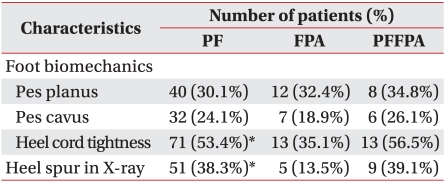
Heel cord tightness was the most common biomechanical problem and limited ankle dorsiflexion was more frequently observed in patients with PF (53.4%) than in patients with FPA (35.1%) (p=0.049). The number of patients with pes planus was greater than that of patients with pes cavus in each group (PF 30.1%, FPA 32.4%, PFFPA 34.8%) (Table 4).
Heel spur by X-ray
We detected heel spurs in PF patients using X-ray (38%) (Table 4). Heel spur occurred more frequently in PF patients than in FPA patients according to a student t-test (p=0.001).
Risk factors for PF or FPA
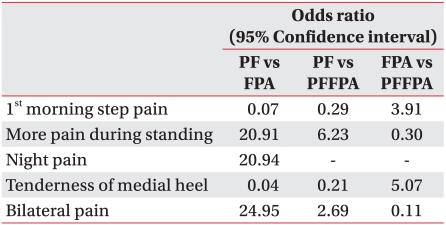
PF and FPA were compared by multinomial logistic regression. Patients with FPA were likely to have pain aggravated by prolonged standing (odds ratio=20.91), night pain (odds ratio=20.94) and bilateral pain (odds ratio=24.95) without first-step pain in the morning (odds ratio=0.07) and tenderness on the medial calcaneal tuberosity (odds ratio=0.04). If the pain was bilateral and more severe with prolonged standing, it was likely to be caused by FPA. PFFPA was compared with PF and FPA by multinomial logistic regression. Morning first-step pain or medial calcaneal tenderness correlated with more significantly PFFPA than FPA (Table 5).
DISCUSSION
PF is reported to be the most common cause of pain in the inferior heel. It is estimated to account for 11-15% of all foot symptoms that require professional care among adults,10,11 and occurs in up to 10% of the US population.12 The incidence peaks between the age of 40 and 60 years in the general population.1,3 PF was the most common diagnosis in this study, occurring in 53.2% of patients with plantar heel pain. PF is caused by repetitive pronatory stress that increases tensile force on the plantar fascia, causing the plantar arch to lower. The pronatory effect increases with age, and is related to limited ankle dorsiflexion caused by decreased elasticity of the tendons, and the reduced range of motion that occurs with age. PF usually has diverse causes. We investigated variable causes of plantar heel pain and their incidence. Interestingly, the fourth most common was PFFPA. Aging caused physiological changes leading to PF, increasing stress on the calcaneus and plantar fascia because of loss of buffering tissue such as water and collagen of the fat pad. The fat pad atrophied and shock absorbency diminished in subjects that were older than 40 years. PF can be co-morbid with FPA, and this should be considered in designing treatment strategy. Our study had 38 people (15.2%) with pes cavus or pes planus and no structural abnormality of the heel. They had been misdiagnosed as having PF and treated with conservative therapy including local steroid injection. Because patients with pes cavus or pes planus might develop sufficient plantar pain to require professional care at a hospital, either condition should be considered in differential diagnosis. Our study had four patients with plantar fascia rupture (1.6%). One had heel pain after running on a treadmill, and the other three patients reported a past medical history of local steroid injection for heel pain. One of these three had two steroid injections and another developed pain during basketball game, 4 months after a steroid local injection. The other patient described an audible "pop" while walking 2 months after a local steroid injection.
The peak age of incidence of PF in the general population is between 40 and 60 years.1,3 In this study, the mean age of patients with PF was 44.7 years. PF patients under 40 years (42.9%) were obese, or had occupations and leisure activities that could lead to heel pain.1,3,5 Younger patients may also be more interested in quality of life and heel pain.
Baxter and Pfeffer6 reported on 69 heels from 53 patients with chronic heel pain who had a surgical release of the first branch of the lateral plantar nerve. Postoperatively, 61 heels (89%) had good or excellent results. Entrapment of the first branch of the lateral plantar nerve (Baxter's nerve) was not determined in this study, but 12 patients (15.3%) with FPA and 3 (13.0%) with PFFPA had tingling, cold, or burning sensations. Tingling or burning symptoms may be the result of neural causes. Nerves are localized in superficial regions where they can be easily compressed after atrophy of the heel fat pad. This makes them vulnerable to contusion if shock absorbency is reduced. Entrapment of the Baxter nerve was difficult to be examined objectively, so this study did not confirm that diagnosis, although this may have occurred among the subjects.
Because PF and FPA may share very similar symptoms and are difficult to distinguish from one another, we performed multinomial logistic regression for statistical modeling and predicting specific diagnoses. When we compared PF with FPA, first-step pain in the morning and tenderness on the medial calcaneal tuberosity tended to indicate PF, and worsening pain during prolonged standing, pain at night, or bilateral pain were more likely to indicate FPA. However, 43.2% of FPA patients experienced first-step pain in the morning. Consequently, we should not make a diagnosis based on only one symptom, and should consider other symptoms, results of physical examinations, and radiologic evaluation. In case of mixed characteristics of PF and FPA (Table 5), PFFPA should be considered first and ultrasonography possibly used as an adjuvant diagnostic tool. Bilateral pain of PF patients was reported in 33% of patients with heel pain1, and this occurred in 23.3% of patients in this study, but unilateral pain was still dominant. Bilateral pain was seen in 78.4% of patients with FPA, and was significantly more likely to indicate FPA than PF (odds ratio=57.22).
Limited ankle dorsiflexion on the involved side significantly increased the risk of PF.5,13 Approximately 10 degrees of ankle dorsiflexion with the knee extended was required during a normal gait.14 If the Achilles tendon is shortened, limiting ankle dorsiflexion, excessive pronation of the foot may occur to compensate for this limitation. Excessive pronation of the foot increases tensile loads on the plantar aponeurosis. Because heel cord tightness of patients with PF was more frequently seen in patients with PF than in patients with FPA (p=0.049), the greater the limitation in ankle dorsiflexion, the more load on the plantar fascia. This provides a good target for treatment. Digiovanni et al.15 reported relief or absence of plantar heel pain in 52% of patients participating in exercises to stretch the plantar fascia, and 22% after stretching the Achilles tendon. Even though the pathophysiology of PF is different from that of FPA, Achilles tendon stretching can be suggested as a part of treatment. Studying the effect of exercise intervention to reduce risk and lower incidence would be worthwhile.
Relationship between heel spur and plantar heel pain has been controversial. Davies et al.16 and Williams et al.17 checked for heel spurs in more than 50% of patients with plantar heel pain. Dimarcangelo and Yu18 looked for it in 50% of patients with PF, and some asymptomatic subjects or subjects without PF. This study showed that 38.3% of patients with PF had spurs, compared with 13.5% of those with FPA (p=0.001). No significant differences between PF and heel spur by multinomial logistic regression were observed.
A limitation of this study is that treatment and evaluation of effects after treatment were not investigated. For example, inferior heel pain from PF can be relieved with a prefabricated insole or heel cushion cup to minimize extension of the plantar fascia. Stretching exercises of the plantar fascia and Achilles tendon cab also relieved pain. An alternative treatment may be steroid local injection, or extracorporeal shock wave therapy for intractable pain. Heel cushions, heel cups, or low-dye taping can be applied to relieve the pressure on the calcaneus of FPA patients.1-3
Accurate diagnosis is important to evaluate the response of treatment and prognosis of disease because treatment such as local steroid injection can cause the atrophied tissue to shrink further in FPA patients. This study determined the causes of plantar heel pain in 250 subjects and gathered basic data on the incidence of the causes of plantar heel pain, and clinical differences and differential diagnosis in 133 subjects with PF and 37 patients with FPA. In the future, we also plan to evaluate the response to treatment.
CONCLUSION
Plantar heel pain can be caused by not only PF or FPA, but various other causes as well. Patients with PF or FPA typically show different characteristics of clinical features about timing of pain, tender site, and bilaterality. Plantar heel pain requires differential diagnosis with consideration for appropriate management.
REFERENCES
1. Buchbinder R. Clinical practice. Plantar fasciitis. N Engl J Med 2004;350:2159-2166.
5. Riddle DL, Pulisic M, Pidcoe P, Johnson RE. Risk factors for plantar fasciitis: a matched case-control study. J Bone Joint Surg Am 2003;85-A:872-877.
6. Baxter DE, Pfeffer GB. Treatment of chronic heel pain by surgical release of the first branch of the lateral plantar nerve. Clin Orthop Relat Res 1992;279:229-236.
8. Rhee WI, Kim JM. Ultrasonographic findings of thickness and compressibility of heel pads in outpatient. J Korean Soc Med Ultrasound 2004;23:213-218.
9. Gould N. Graphing the adult foot and ankle. Foot Ankle 1982;2:213-219.
11. Pfeffer G, Bacchetti P, Deland J, Lewis A, Anderson R, Davis W, Alvarez R, Brosdsky J, Cooper P, Frey C, et al. Comparison of custom and refabricated orthoses in the initial treatment of proximal plantar fasciitis. Foot Ankle Int 1999;20:214-221.
12. Riddle DL, Schappert SM. Volume of ambulatory care visits and patterns of care for patients diagnosed with plantar fasciitis: a national study of medical doctors. Foot Ankle Int 2004;25:303-310.
PF: Plantar fasciitis, FPA: Fat pad atrophy, PFFPA: PF with FPA
Table 3
Characteristics of Plantar Heel Pain
PF: Plantar fasciitis, FPA: Fat pad atrophy, PFFPA: PF with FPA
Table 4
Physical Examination and Heel Spur using X-ray
PF: Plantar fasciitis, FPA: Fat pad atrophy, PFFPA: PF with FPA
*p<0.05
Table 5
Risk Factors of Plantar Fasciitis or Fat Pad Atrophy
PF: Plantar fasciitis, FPA: Fat pad atrophy, PFFPA: PF with FPA
Figure & Data
References
Citations
Citations to this article as recorded by
Exploring the role of heel pad thickness in lower limb biomechanics and plantar pressure during running Hyun Kyung Kim, Ali Karimi Azandariani, Megan Gordon, Seyed Ali Mirjalili Gait & Posture.2026; 123: 109971. CrossRef
Body Mass Index Predicts Function in Individuals With Plantar Fasciopathy: A Longitudinal Observational Study Fernanda Colen Milagres Brandão, Ana Paula Coelho Figueira Freire, Daniel Barreto Rabelo, Sabrina Oliveira Melo, Mario Efraín Recinos Mastahinich, Roberto Zambelli, Thales R. Souza, Rafael Z. Pinto Journal of Sport Rehabilitation.2025; 34(4): 380. CrossRef
Static and dynamic optimisation of fluid-filled responsive orthotic insoles Dayna Cracknell, Mark Battley, Justin Fernandez, Maedeh Amirpour Biomechanics and Modeling in Mechanobiology.2025; 24(2): 713. CrossRef
Fat grafting for pedal fat pad atrophy: A narrative review of the literature George Bcharah, Sailesh V. Tummala, Collin L. Braithwaite, Phillip J. Karsen, Karan A. Patel The Journal of Foot and Ankle Surgery.2025; 64(6): 835. CrossRef
Research Progress on Non-Surgical Treatment of Plantar Fasciitis with Traditional Chinese and Western Medicine 丽彩 韦 Traditional Chinese Medicine.2025; 14(07): 3094. CrossRef
Superficial plantar foreign body mimicking plantar fasciitis: A case report Huabin Chen, Feng Zhang International Journal of Surgery Case Reports.2025; 137: 112128. CrossRef
“Antero-medial load shift” in unilateral plantar heel pain – A cross-sectional exploratory study Gopisankar Balaji, Mohanakrishnan Jagadevan, Bhanumathy Mohanakrishnan, Salaja Murugesan, Pasupathy Palaniappan Journal of Bodywork and Movement Therapies.2024; 37: 151. CrossRef
Optimum Insole Hardness for Attenuating Peak Plantar Pressure Under Simulated Loading Scenarios Maimaitirexiati Helili, Xiang Geng, Chao Zhang, Jiazhang Huang, Wenming Chen International Journal of Gaming and Computer-Mediated Simulations.2024; 16(1): 1. CrossRef
Plantar Fascia Thickness and Stiffness in Healthy Individuals vs Patients With Plantar Fasciitis Tanwarat Thanwisate, Palanan Siriwanarangsun, Sitha Piyaselakul, Theerawoot Tharmviboonsri, Bavornrit Chuckpaiwong Foot & Ankle International.2024; 45(11): 1270. CrossRef
Effectiveness of joint mobilization on heel fat pad syndrome among obese patient in geriatric population N. Sathiyaseelan, Shenbaga Sundaram Subramanian, A Kumaresan, Surya Vishuram, K.C. Gayathri, Madhanraj Sekar, A.K. Keerthana Fizjoterapia Polska.2024; 24(4): 71. CrossRef
The association of demographic, psychological, social and activity factors with foot health in people with plantar heel pain Halime Gulle, Dylan Morrissey, Abdulhamit Tayfur, Dilber Karagozoglu Coskunsu, Stuart Miller, Aleksandra V. Birn‐Jeffery, Trevor Prior Journal of Foot and Ankle Research.2024;[Epub] CrossRef
Plasma rico en plaquetas como opción terapéutica en el síndrome de la almohadilla grasa plantar M. García Garrido, J. Formigo Couceiro, M. Alonso Bidegaín Rehabilitación.2023; 57(3): 100743. CrossRef
Myofascial stiffness of plantar fascia and Achilles tendon in individuals with plantar fasciopathy: An observational cross-sectional study Daniel Barreto Rabelo, Ana Paula Coelho Figueira Freire, Fernanda Colen Milagres Brandão, Sabrina Oliveira Melo, Juliana M. Ocarino, Marco Tulio Saldanha dos Anjos, Robert Schleip, Thales R. Souza, Guy Simoneau, Rafael Zambelli Pinto Musculoskeletal Science and Practice.2023; 66: 102781. CrossRef
A New Minimally Invasive Procedure for Treating Plantar Heel Pain Bihua Wu, Shune Xiao, Sanhong Yang, Zairong Wei, Chengliang Deng Annals of Plastic Surgery.2023; 91(5): 609. CrossRef
Treatment of Plantar Fasciitis in Patients with Calcaneal Spurs: Radiofrequency Thermal Ablation or Extracorporeal Shock Wave Therapy? Nevsun Pihtili Tas, Oğuz Kaya Journal of Clinical Medicine.2023; 12(20): 6503. CrossRef
FUNCTIONAL OUTCOME OF PATIENTS WITH CHRONIC PLANTAR FASCIITIS TREATED BY LOCAL INJECTION OF AUTOLOGOUS PLATELET-RICH PLASMA RAJESH KUMAR KANOJI, PRADEEP KUMAR SUTHAR, HIMANSHU Asian Journal of Pharmaceutical and Clinical Research.2023; : 191. CrossRef
Ruptures of the Plantar Fascia: A Systematic Review of the Literature Massimiliano Mosca, Mario Fuiano, Simone Massimi, Davide Censoni, Giuseppe Catanese, Alberto Grassi, Silvio Caravelli, Stefano Zaffagnini Foot & Ankle Specialist.2022; 15(3): 272. CrossRef
A problem-based approach in musculoskeletal ultrasonography: heel pain in adults Yong Hee Kim, Jee Won Chai, Dong Hyun Kim, Hyo Jin Kim, Jiwoon Seo Ultrasonography.2022; 41(1): 34. CrossRef
A Deep Learning Method for Foot Progression Angle Detection in Plantar Pressure Images Peter Ardhianto, Raden Bagus Reinaldy Subiakto, Chih-Yang Lin, Yih-Kuen Jan, Ben-Yi Liau, Jen-Yung Tsai, Veit Babak Hamun Akbari, Chi-Wen Lung Sensors.2022; 22(7): 2786. CrossRef
Influencia de la densidad de energía de ondas de choque focalizadas en el tratamiento de la fascitis plantar Ana María Andrés Toribio, Ana María González Rebollo, Antonio Tristán-Vega, Manuel Garrosa Investigación Clínica.2022; 63(1): 32. CrossRef
Heel pain caused by os subcalcis: A case report Saijilafu Saijilafu, Suo-Yuan Li, Xiao Yu, Zhi-Qiang Li, Guang Yang, Jing-Huan Lv, Guang-Xiang Chen, Ren-Jie Xu World Journal of Clinical Cases.2022; 10(16): 5373. CrossRef
Age, Body Mass Index, and Spur Size Associated with Patients’ Symptoms in Plantar Fasciitis Bong Wan Cho, Ji Hye Choi, Hee Soo Han, Woo-Young Choi, Kyoung Min Lee Clinics in Orthopedic Surgery.2022; 14(3): 458. CrossRef
The relationship between ultrasonography with or without contrast and the clinical outcome in plantar fasciitis Finn Johannsen, Stig Peter Magnusson Scandinavian Journal of Medicine & Science in Sports.2022; 32(11): 1660. CrossRef
What do we actually know about a common cause of plantar heel pain? A scoping review of heel fat pad syndrome Alison H. Chang, Steven Zartov Rasmussen, Asger Emil Jensen, Thomas Sørensen, Michael Skovdal Rathleff Journal of Foot and Ankle Research.2022;[Epub] CrossRef
Calcaneal Spurs: A Potentially Debilitating Disorder Vivek R Velagala, Namrata R Velagala, Tanishq Kumar, Arihant Singh, Ashok M Mehendale Cureus.2022;[Epub] CrossRef
A Comparative Study between Platelet-Rich Plasma, Corticosteroid, and Autologous Whole Blood Injection in Patient of Plantar Fasciitis Utkarsh Ravikant, Ashish Kumar, Imran Sajid, Siddharth Dubey, Shashank Kumar Pal Journal of Bone and Joint Diseases.2022; 37(3): 141. CrossRef
Foot fat pad: Characterization by mesenchymal stromal cells in rats Zijun Zhang, Sharada Paudel, Tyler Feltham, Mario H. Lobao, Lew Schon The Anatomical Record.2021; 304(7): 1582. CrossRef
Altered Central Pain Processing in Patients With Chronic Plantar Heel Pain: A Critically Appraised Topic Dhinu J. Jayaseelan, Cesar Fernandez-de-las-Penas, Taylor Blattenberger, Dean Bonneau Journal of Sport Rehabilitation.2021; 30(5): 812. CrossRef
A Step in the Right Direction: A Prospective Randomized, Controlled Crossover Trial of Autologous Fat Grafting for Rejuvenation of the Heel Isaac B James, Beth R Gusenoff, Sheri Wang, Gabriella DiBernardo, Danielle Minteer, Jeffrey A Gusenoff Aesthetic Surgery Journal.2021; 41(7): NP959. CrossRef
Heel fat pad syndrome beyond acute plantar fascitis Ramon Balius, Mireia Bossy, Carles Pedret, Carme Porcar, Xavier Valle, Hèctor Corominas The Foot.2021; 48: 101829. CrossRef
A Systematic Review of Systematic Reviews on the Epidemiology, Evaluation, and Treatment of Plantar Fasciitis Hye Chang Rhim, Jangwon Kwon, Jewel Park, Joanne Borg-Stein, Adam S. Tenforde Life.2021; 11(12): 1287. CrossRef
Physical therapist decision-making in managing plantar heel pain: cases from a pragmatic randomized clinical trial Shane McClinton, Bryan Heiderscheit, Thomas G. McPoil, Timothy W. Flynn Physiotherapy Theory and Practice.2020; 36(5): 638. CrossRef
Effect of Weight-bearing Pattern and Calcaneal Taping on Heel Width and Plantar Pressure in Standing DoYoung Jung The Journal of Korean Physical Therapy.2020; 32(1): 29. CrossRef
The Relationship between Calcaneal Spur Type and Plantar Fasciitis in Chinese Population Lei Zhang, Han-wen Cheng, Lu-jing Xiong, Zhang-rong Xia, Meng-yao Zhang, Shi-jie Fu, Guo-you Wang, Friedrich P. Paulsen BioMed Research International.2020;[Epub] CrossRef
The Evaluation of Radiologic Angular Measurements in Patients with Foot Pain Gulnihal Deniz, Arzu Kaya, Zubeyde Ercan, Ahmet Kavakli, Murat Ogeturk Journal of the American Podiatric Medical Association.2020;[Epub] CrossRef
Effectiveness of physical therapy treatment in addition to usual podiatry management of plantar heel pain: a randomized clinical trial Shane M. McClinton, Bryan C. Heiderscheit, Thomas G. McPoil, Timothy W. Flynn BMC Musculoskeletal Disorders.2019;[Epub] CrossRef
Low back pain and disability in individuals with plantar heel pain Shane McClinton, Carolyn F. Weber, Bryan Heiderscheit The Foot.2018; 34: 18. CrossRef
Does manual therapy improve pain and function in patients with plantar fasciitis? A systematic review John J. Fraser, Revay Corbett, Chris Donner, Jay Hertel Journal of Manual & Manipulative Therapy.2018; 26(2): 55. CrossRef
Clinical and Biomechanical Effects of Low-Dye Taping and Figure-8 Modification of Low-Dye Taping in Patients With Heel Pad Atrophy You Hyeon Chae, Joo Sup Kim, Yeon Kang, Hyun Young Kim, Tae Im Yi Annals of Rehabilitation Medicine.2018; 42(2): 222. CrossRef
Effectiveness of Four Different Treatment Modalities in the Treatment of Chronic Plantar Fasciitis During a 36-Month Follow-Up Period: A Randomized Controlled Trial Meriç Uğurlar, Mesut Mehmet Sönmez, Özge Yapıcı Uğurlar, Levent Adıyeke, Hakkı Yıldırım, Osman Tuğrul Eren The Journal of Foot and Ankle Surgery.2018; 57(5): 913. CrossRef
Patología de la aponeurosis plantar J. Damiano EMC - Podología.2018; 20(4): 1. CrossRef
Pathologies de l’aponévrose plantaire J. Damiano EMC - Podologie.2018; 20(3): 1. CrossRef
Gait deviations associated with plantar heel pain: A systematic review Adam Phillips, Shane McClinton Clinical Biomechanics.2017; 42: 55. CrossRef
Applicability of contrast‐enhanced ultrasound in the diagnosis of plantar fasciitis R. Broholm, J. Pingel, L. Simonsen, J. Bülow, F. Johannsen Scandinavian Journal of Medicine & Science in Sports.2017; 27(12): 2048. CrossRef
Rupturas de la fascia plantar J. Damiano EMC - Podología.2017; 19(4): 1. CrossRef
Ruptures de l’aponévrose plantaire J. Damiano EMC - Podologie.2017; 19(3): 1. CrossRef
Complications of Intra-articular Calcaneal Fractures in Adults Christos Koutserimpas, George Magarakis, Grigoris Kastanis, George Kontakis, Kalliopi Alpantaki Foot & Ankle Specialist.2016; 9(6): 534. CrossRef
Relationship and Classification of Plantar Heel Spurs in Patients With Plantar Fasciitis Jamal Ahmad, Ammar Karim, Joseph N. Daniel Foot & Ankle International.2016; 37(9): 994. CrossRef
Predictors of Response to Physical Therapy Intervention for Plantar Heel Pain Shane M. McClinton, Joshua A. Cleland, Timothy W. Flynn Foot & Ankle International.2015; 36(4): 408. CrossRef
Systematic review: plantar fasciitis and prolonged weight bearing E. R. Waclawski, J. Beach, A. Milne, E. Yacyshyn, D. M. Dryden Occupational Medicine.2015; 65(2): 97. CrossRef
Heel Pad Stiffness in Plantar Heel Pain by Shear Wave Elastography Che-Yu Lin, Chen-Chiang Lin, Yang-Chen Chou, Pei-Yu Chen, Chung-Li Wang Ultrasound in Medicine & Biology.2015; 41(11): 2890. CrossRef
18F-FDG-avid plantar nodules on true whole-body 18F-FDG PET/CT in cancer patients Razi Muzaffar, Osama Raslan, Medhat M. Osman Nuclear Medicine Communications.2015; 36(9): 881. CrossRef
Deep massage to posterior calf muscles in combination with neural mobilization exercises as a treatment for heel pain: A pilot randomized clinical trial Bernice Saban, Daniel Deutscher, Tomer Ziv Manual Therapy.2014; 19(2): 102. CrossRef
Heel Pain—Plantar Fasciitis: Revision 2014 Robroy L. Martin, Todd E. Davenport, Stephen F. Reischl, Thomas G. McPoil, James W. Matheson, Dane K. Wukich, Christine M. McDonough, Roy D. Altman, Paul Beattie, Mark Cornwall, Irene Davis, John DeWitt, James Elliott, James J. Irrgang, Sandra Kaplan, Ste Journal of Orthopaedic & Sports Physical Therapy.2014; 44(11): A1. CrossRef
Re-irradiation for painful heel spur syndrome M.G. Hautmann, U. Neumaier, O. Kölbl Strahlentherapie und Onkologie.2014; 190(3): 298. CrossRef
A stereologic study of the plantar fat pad in young and aged rats Jeremy Molligan, Lew Schon, Zijun Zhang Journal of Anatomy.2013; 223(5): 537. CrossRef
Comparison of usual podiatric care and early physical therapy intervention for plantar heel pain: study protocol for a parallel-group randomized clinical trial Shane M McClinton, Timothy W Flynn, Bryan C Heiderscheit, Thomas G McPoil, Daniel Pinto, Pamela A Duffy, John D Bennett Trials.2013; 14(1): 414. CrossRef