Department of Rehabilitation Medicine, Konyang University College of Medicine, Daejeon, Korea.
Corresponding author: Yung-Jin Lee. Department of Rehabilitation Medicine, Konyang University College of Medicine, 158 Gwanjeodong-ro, Seo-gu, Daejeon 302-718, Korea. Tel: +82-42-600-6700, Fax: +82-42-600-9090, eutravel@kyuh.ac.kr
• Received: July 17, 2014 • Accepted: September 11, 2014
This is an open-access article distributed under the terms of the Creative Commons Attribution Non-Commercial License (http://creativecommons.org/licenses/by-nc/3.0/) which permits unrestricted noncommercial use, distribution, and reproduction in any medium, provided the original work is properly cited.
To evaluate the effect of post-stroke depression (PSD) on rehabilitation outcome and to investigate the risk factors of PSD, especially, the role of caregivers type (family or professional) in subacute stroke patients.
Methods
Two hundred twenty-six stroke patients were enrolled retrospectively. All the subjects' basic characteristics, Korean version of the Beck Depression Inventory (K-BDI), Korean version of the Modified Barthel Index (K-MBI), and the modified Rankin Scale (mRS) were recorded when the patient was transferred into the Department of Rehabilitation Medicine and at the time of discharge. The results were statistically analyzed by using SPSS ver. 20.0.
Results
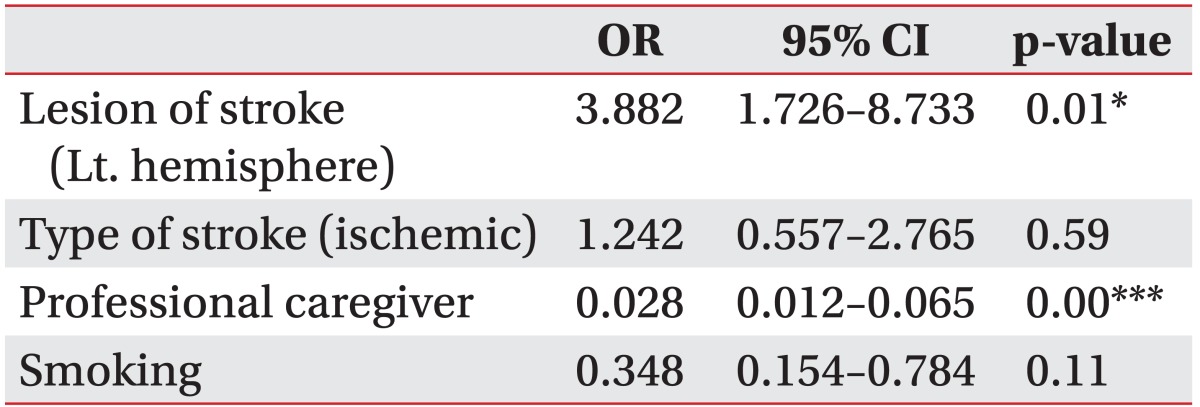
The patients' K-BDI score showed a significantly negative association with K-MBI at discharge (β=-0.473, p<0.001) and a significantly positive association with the mRS score at discharge (β=0.316, p<0.001). Patients with lesions on the left hemisphere (odds ratio [OR], 3.882; 95% confidence interval [CI], 1.726-8.733) and professional caregiver support (OR, 0.028; 95% CI, 0.012-0.065) had a higher rate of depression.
Conclusion
Depression was prevalent in stroke patients, and it had a negative effect on patients' functional outcome. Patients who had a lesion on the right hemisphere had less depression. The type of caregiver was related to the incidence of subacute PSD, and family caregivers were found to lower the frequency of stroke patients' depression.
Every year, about 16 million people in the world have their first strokes [1], and stroke is the second leading cause of death in Korea [2]. Stroke survivors have an increased incidence of neuropsychiatric disorders, such as generalized anxiety disorders, psychotic states, secondary mania, apathy, obsessive disorders, and depression [3]. Among these, depression is one of the most common neuropsychiatric disturbances in first few months following a stroke, occurring in 20%-65% of stroke patients [4,5]. It is so-called post-stroke depression (PSD). PSD has been negatively associated with survival, cost of medical care, and compliance with therapy including rehabilitation, functional outcome, resumption of social activities, and quality of life [6].
Studies have been conducted to better describe the relationship between stroke and depression. Kauhanen et al. [7] reported that PSD is related to dependence with respect to activities of daily living, and to the severity of neurological deficits. Whyte and Mulsant [8] suggested a possible biological relationship between depression and structural brain injury caused by a stroke. In addition, Anderson et al. [9] proposed that cerebrovascular risk factors increase the risk of depression.
Care is an important issue for stroke patients suffering from neurological deficits. Particularly among acute and subacute stroke patients, those with moderate to severe impairment have to depend on others to accomplish most of their activities of daily living and such roles are csarried out by their main caregivers [2]. Such care has usually been performed by the family, but care by professional caregivers is now being widely used in response to the structural change of Korean society resulting from the increasing life expectancy and elderly population [10,11]. Therefore, in this study, we investigated the type of caregiver (family or professional caregiver) and their effect in stroke patients' depression.
Although the relationship between stroke and depression is described extensively in literature worldwide, there are limited studies in Korea pertaining to the risk factors of PSD in patients at a subacute stage of stroke and regarding the effect of PSD on rehabilitation outcome. The aims of this study are to evaluate the effect of PSD on rehabilitation outcome and to investigate the risk factors of PSD, especially, the role of caregiver type (family or professional) as a risk factor for stroke patients' subacute PSD.
MATERIALS AND METHODS
Study design
This is a retrospective observation study.
Subjects
Data from stroke patients who were transferred into the Department of Rehabilitation Medicine of Konyang University Hospital from January 2011 to December 2013 were retrospectively recruited from the patients' medical records. Before being transferred in, the patients were treated in the Department of Neurology or Neurosurgery of our hospital. The patients' average duration from the onset of stroke was 11.93±2.43 days.
Inclusion criteria were (1) patients over 18 years of age who underwent their first stroke; (2) confirmed diagnosis of stroke by medical records, imaging study, and clinical examination; and (3) patients who had never suffered from psychiatric disorders before the stroke. Exclusion criteria included the following: (1) transient ischemic attack, subdural hematoma, or subarachnoid hemorrhage; (2) history of any central nervous system disease other than stroke; (3) severe cognitive impairment as defined by the Korean version of the Mini-Mental State Examination (MMSE-K) score of <19 [12]; (4) severe auditory or visual impairment; and (5) recurrent stroke before assessment.
Depression
Depression was measured by using the Korean version of the Beck Depression Inventory (K-BDI), which is commonly used to evaluate depression. It consists of 21 questions (scoring up to 63 points) and a score higher than 10 is considered to represent depressive symptoms [13]. The K-BDI was measured 3 to 4 weeks (24±2.32 days) after the transfer, and the survey was conducted by a clinical psychologist in our hospital. To find the correlation between depression and factors, the patients were divided into two groups by a cutoff score of 10 [14].
Functional outcome measures
The functional outcomes of stroke patients were measured using the Korean versions of the Modified Barthel Index (K-MBI) [15] and the modified Rankin Scale (mRS) [16] upon transfer into the Department of Rehabilitation Medicine of Konyang University Hospital and at the time of discharge.
The K-MBI is a Korean translation of the 5th version of MBI, translated by Jung et al. [15]. It consists of 10 items, and its score ranges from 0 to 100, with a high score meaning that the stroke patient functions well. It is considered to be a reliable and valid instrument for evaluating the functional status of subjects with stroke.
The mRS is a tool that has a score range from 0 to 6, with a high score representing a poor functional outcome. This tool is efficient in assessing stroke patients' functions [16].
Statistical analyses
Statistical analyses were performed using SPSS ver. 20.0 (IBM SPSS Inc., Armonk, NY, USA). The baseline demographic characteristics of stroke patients were analyzed. A multiple linear regression model was used to examine the association between depression and functional outcome. In order to find the association of various factors with depression, Pearson correlation test, Pearson chi-square test, and a linear logistic regression model were used. Statistical significance was assigned at p-values less than 0.05.
RESULTS
Depression and functional outcomes of stroke patients
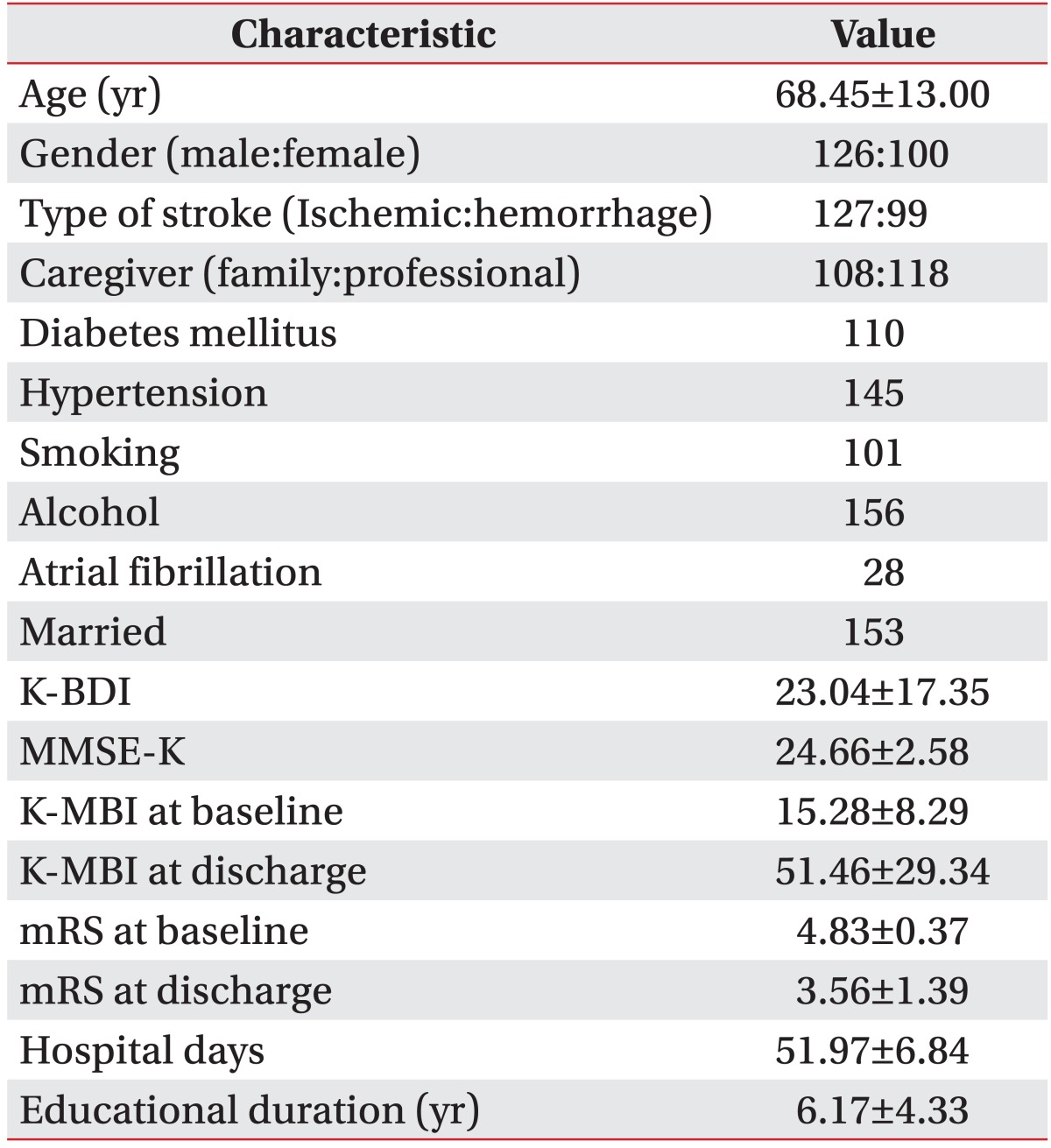
A total of 226 patients were recruited in the study. The mean age of the patients was 68.45±13.00 years and the mean BDI score was 23.04±17.35 points. The patients' functional outcomes were all improved at discharge. Other demographic and general characteristics of the patients are listed in Table 1.
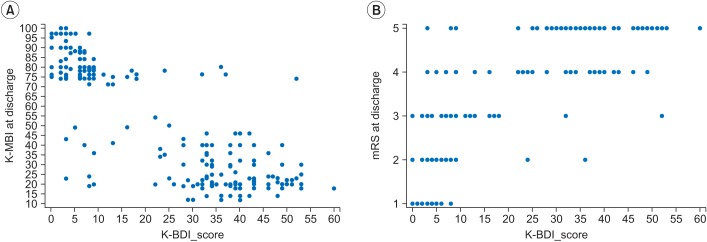
The association between the initial factors and functional outcomes are listed in Table 2. The BDI score of stroke patients showed a significantly negative association with the K-MBI at discharge (β=-0.473, p<0.001) and a significantly positive association with the mRS score at discharge (β=0.316, p<0.001). Fig. 1A and B are scatter plots showing the relationship between the K-BDI and functional outcomes (K-MBI, mRS) at discharge.

Various factors and depression
Using a cutoff value of the BDI score, the stroke patients were divided into two groups. Those with a BDI score <10 were the non-depressed group, and those with a BDI≥10, the depressed group. Table 3 contains the association between various factors and depression. A lesion on the left hemisphere, smoking history, and support by a professional caregiver showed a significant association with stroke patients' depression (p<0.05). There was no significant association between the other factors we examined and depression.
Table 4 shows the result of linear logistic regression analysis of factors that influence the depression of stroke patients. Patients with a lesion on the left hemisphere (odds ratio [OR], 3.882; 95% confidence interval [CI], 1.726-8.733) and professional caregiver support (OR, 0.028; 95% CI, 0.012-0.065) had higher rates of depression.
DISCUSSION
In this study, more than half of the patients had depressive symptoms. This prevalence rate agrees with the study of Farner et al. [17], which reported 56% prevalence rate of PSD. We found that PSD patients had poor functional outcomes at discharge. This finding corresponds with that of Schmid et al. [18]. They investigated 174 patients with PSD over 12 weeks and found that the severity of depression symptoms was negatively associated with the patients' functional independence. As one of the main goals of stroke rehabilitation is restoring the patients' functional outcomes, this finding reinforces the importance of treatment for PSD in stroke rehabilitation.
Also, we investigated several factors of depression. We found patients who had a lesion on their right hemispheres had lower rates of depression. The type of caregiver had a significant effect on the incidence of subacute PSD, and patients supported by a family caregiver showed a lower frequency of depression. However, sex, past history of certain conditions (hypertension, smoking, dyslipidemia, marital status, and educational duration), and type of stroke were not associated with subacute PSD.
The risk factors of PSD in the present study are comparable to those found in other studies. In our study, age was not associated with PSD. This finding is consistent with that of Brown et al. [19] and Fuentes et al. [20]. They found no association between depression and age. According to the study of Berg et al. [21], however, age was the most significant determinant of depression and older patients were more depressed after suffering acute strokes. This difference might be because the patients recruited in our study were older (68.45±13.00 years) than those in other studies, and therefore the effect of age was muted. As shown in our study, a large number of patients had their first stroke at an advanced age. For elderly patients, therefore, age may not be a determinant of depression.
In our study, sex was not associated with PSD. Kotila et al. [22] reported that the female sex is associated with depression. However, Berg et al. [23] reported that, in a chronic phase, men seemed to be more depressed than women. According to the study of Berg et al. [23], the nature of PSD may be different between the two sexes and men are more concerned about working disability and have a poorer coping ability than women. The discrepancy between our study and others is likely due to the period of investigation. Patients recruited in our study were investigated within 3 months of having their strokes.
In this study, cognitive function measured by the MMSE-K was not related to PSD. Some studies evaluated the relationship between decreased cognitive function and depression. In our study, however, cognitively impaired patients with a low MMSE-K score and aphasia patients were excluded by criteria, and this confounded the effect of cognitive function as a risk factor of depression [12].
Furthermore, our study found that a lesion on the left hemisphere was associated with depression. Our finding is consistent with the study of Paradiso and Robinson [24] which suggested that depression was associated with lesions on the left hemisphere as well. However, some studies found no association between stroke lesions and depression [12,19]. The significance of our result is proposed by the concept of anosognosic disturbance. Stroke patients who are able to realize their disabilities respond to depressive symptoms soon after stroke, but this normal reaction is lacking in patients who suffer anosognosic disturbances. Because anosognosic disturbances are known to occur in right hemisphere lesions in an acute phase, the prevalence of depressive disorders may be higher after a left hemisphere stroke [21]. Furthermore, Bhogal et al. [25] reviewed the relevant literature and proposed that when inpatient population studies were compared with community-based studies, PSD of left hemisphere lesion stroke patients was more frequent in the inpatient population. As the subjects in our study were an inpatient population, this might influence the result. However, the association between the site of the stroke lesion and the likelihood of the development of depression remains controversial [21,25].
This study is significant in that, to the best of the author's knowledge, it is the first study to investigate the type of caregiver as a risk factor of PSD. Previous studies have focused on caregivers' depression and suggested that caregivers can easily be depressed by their burdens. They emphasized that it would be important to identify depressed caregivers [26,27]. Approaching this situation from a different viewpoint, however, this study found that patients supported by a family caregiver showed remarkably fewer depression symptoms. Furthermore, such patients showed good functional outcomes. Previous studies compared the course of the illness at day hospitals and outpatient services with that at home care, and found great advantages in the latter [28,29]. These findings suggest that family members play important roles by offering emotional encouragement and helping compliance with therapeutic instructions because most of patients are mostly dependent, disabled, or both [30]. Also, Tsouna-Hadjis et al. [31] investigated 43 first-stroke patients and reported that high-level family support is associated with an improvement of depression and functional outcomes in acute-stage stroke patients. Therefore, even though the number of professional caregivers is increasing in Korea [11], family caregivers can give physical and psychological support that is more desirable and effective from the stroke survivors' points of view.
There are several limitations in this study. First, the retrospective nature of the study may influence the results. Second, the K-BDI was the only tool to investigate depression. However, the K-BDI is used widely and its reliability and validity for screening PSD have been wellestablished [32]. Third, we did not examine other risk factors of PSD, such as the severity of stroke and the type of PSD symptoms. Fourth, the period of investigation was short and the number of subjects enrolled was small, limiting its applicability to a more general population. The last limitation is that stroke patients were divided dichotomously into the depressive and non-depressive groups. Further research is required for these limitations.
In conclusion, depression was prevalent in stroke patients, and it has a negative effect on patients' functional outcome. Because the patients' functional status improves rapidly in the early period of rehabilitation, it is necessary to focus on the treatment of depression. Also, family caregivers' support can improve the patients' depression and it can be a modifiable factor. Therefore, the rehabilitation team should take into account it and reflect this fact in planning a treatment schedule.
However, various factors discussed in this study are still controversial. Although many studies have evaluated the risk factors of PSD, debates still remain. Thus, longitudinal prospective research is required in the future, complete with a longer period and a larger number of subjects.
CONFLICTS OF INTEREST
No potential conflicts of interest relevant to this article are reported.
REFERENCES
1. European Stroke Initiative Executive Committee. EUSI Writing Committee. European Stroke Initiative Recommendations for Stroke Management-update 2003. Cerebrovasc Dis 2003;16:311-337.
2. Yoo EK, Jeon S, Yang JE. The effects of a support group intervention on the burden of primary family caregivers of stroke patients. J Korean Acad Nurs 2007;37:693-702.
3. Angelelli P, Paolucci S, Bivona U, Piccardi L, Ciurli P, Cantagallo A, et al. Development of neuropsychiatric symptoms in poststroke patients: a cross-sectional study. Acta Psychiatr Scand 2004;110:55-63.
5. Hackett ML, Yapa C, Parag V, Anderson CS. Frequency of depression after stroke: a systematic review of observational studies. Stroke 2005;36:1330-1340.
9. Anderson RJ, Freedland KE, Clouse RE, Lustman PJ. The prevalence of comorbid depression in adults with diabetes: a meta-analysis. Diabetes Care 2001;24:1069-1078.
13. Lee MK, Lee YH, Park SH, Sohn CH, Jung YJ, Hong SK, et al. A standardization study of Beck Depression Inventory (I): Korean version (K-BDI): reliability land factor analysis. Korean J Psychopathol 1995;4:77-95.
14. Shin JC, Goo HR, Yu SJ, Kim DH, Yoon SY. Depression and quality of life in patients within the first 6 months after the spinal cord injury. Ann Rehabil Med 2012;36:119-125.
15. Jung HY, Park BK, Shin HS, Kang YK, Pyun SB, Paik NJ, et al. Development of the Korean version of Modified Barthel Index (K-MBI): multi-center study for subjects with stroke. J Korean Acad Rehabil Med 2007;31:283-297.
16. van Swieten JC, Koudstaal PJ, Visser MC, Schouten HJ, van Gijn J. Interobserver agreement for the assessment of handicap in stroke patients. Stroke 1988;19:604-607.
17. Farner L, Wagle J, Engedal K, Flekkoy KM, Wyller TB, Fure B. Depressive symptoms in stroke patients: a 13 month follow-up study of patients referred to a rehabilitation unit. J Affect Disord 2010;127:211-218.
20. Fuentes B, Ortiz X, Sanjose B, Frank A, Diez-Tejedor E. Post-stroke depression: can we predict its development from the acute stroke phase? Acta Neurol Scand 2009;120:150-156.
25. Bhogal SK, Teasell R, Foley N, Speechley M. Lesion location and poststroke depression: systematic review of the methodological limitations in the literature. Stroke 2004;35:794-802.
26. Epstein-Lubow GP, Beevers CG, Bishop DS, Miller IW. Family functioning is associated with depressive symptoms in caregivers of acute stroke survivors. ArchPhys Med Rehabil 2009;90:947-955.
27. Tang WK, Lau CG, Mok V, Ungvari GS, Wong KS. Burden of Chinese stroke family caregivers: the Hong Kong experience. Arch Phys Med Rehabil 2011;92:1462-1467.
29. Johansson BB, Jadback G, Norrving B, Widner H, Wiklund I. Evaluation of long-term functional status in first-ever stroke patients in a defined population. Scand J Rehabil Med Suppl 1992;26:105-114.
31. Tsouna-Hadjis E, Vemmos KN, Zakopoulos N, Stamatelopoulos S. First-stroke recovery process: the role of family social support. Arch Phys Med Rehabil 2000;81:881-887.
32. Kang HJ, Stewart R, Kim JM, Jang JE, Kim SY, Bae KY, et al. Comparative validity of depression assessment scales for screening poststroke depression. J Affect Disord 2013;147:186-191.
(A) Scatter plot showing the relationship between Korean version of Beck Depression Inventory (K-BDI) and Korean version of Modified Barthel Index (K-MBI). (B) Scatter plot showing the relation between K-BDI and modified Rankin Scale (mRS).
Table 1
Demographics and characteristics of stroke patients (n=226)
Values are presented as mean±standard deviation or number.
K-BDI, Korean version of Beck Depression Inventory; MMSE-K, Korean version of the Mini-Mental State Examination; K-MBI, Korean version of Modified Barthel Index; mRS, modified Rankin Scale.
Table 2
Association between patients' functional outcome and other initial factors
K-BDI, Korean version of Beck Depression Inventory; MMSE-K, Korean version of the Mini-Mental State Examination; β, regression coefficient.
***p<0.001.
Table 3
Comparison between patients in the non-depressive and depressive groups
MMSE-K, Korean version of Mini-Mental State Examination.
*p<0.05, ***p<0.001.
Table 4
Linear logistic regression model results of predicting depression
Feasibility, usability and engagement of a tangible interface for upper limb rehabilitation after stroke Fábio Pereira, Sergi Bermúdez i Badia, Rúben Ornelas, Mónica S. Cameirão Journal of Stroke and Cerebrovascular Diseases.2025; 34(1): 108164. CrossRef
Social factors related to untreated post stroke depression Alexandra Balshi, John Dempsey, Matthew Z. Farber, Adam Jiadi, Harish Babu General Hospital Psychiatry.2025; 97: 94. CrossRef
Inulin alters gut microbiota to alleviate post‐stroke depressive‐like behavior associated with the IGF‐1‐mediated MAPK signaling pathway Rong Shao, Xiongchang Tan, Minfu Pan, Jiawen Huang, Liu Huang, Binyu Bi, Xiaohua Huang, Jie Wang, Xuebin Li Brain and Behavior.2024;[Epub] CrossRef
Access to inpatient mood management services after stroke in Australian acute and rehabilitation hospitals Shaun L Hancock, Tara Purvis, Tharshanah Thayabaranathan, Rene Stolwyk, Jan Cameron, Lachlan L Dalli, Megan Reyneke, Monique F Kilkenny, Kelvin Hill, Dominique A Cadilhac Clinical Rehabilitation.2024; 38(6): 811. CrossRef
Post-Stroke Depression and Suicidal Ideations: Relationship with Gender and Marital Status: A Cross Sectional Study Mgbeojedo Ukamaka Gloria, Osiri Emmanuel Jonah, Akosile Christopher Olusanjo, Okoye Emmanuel Chiebuka, John Jeneviv Nene, Akobundu Uzoamaka Nwakego, Anyaene Chiamaka Chinyere Journal of Primary Care & Community Health.2024;[Epub] CrossRef
The impact of mental health on shoulder arthroplasty and rotator cuff repair: a meta-analysis Mohammad Daher, Ryan Lopez, Peter Boufadel, Oscar Covarrubias, Jack C. Casey, George A. Casey, Mohamad Y. Fares, Joseph A. Abboud Clinics in Shoulder and Elbow.2024; 27(3): 295. CrossRef
Brain imaging and clinical outcome of embodied VR-BCI training in chronic stroke patients: a longitudinal pilot study Athanasios Vourvopoulos, Mathis Fleury, Diego Andres Blanco-Mora, Jean-Claude Fernandes, Patr´ıcia Figueiredo, Sergi Bermúdez i Badia Brain-Computer Interfaces.2024; 11(4): 193. CrossRef
Trajectory and predictors of post-stroke depression among patients with newly diagnosed stroke: A prospective longitudinal study Yanjin Huang, Jiachun You, Qi Wang, Wen Wen, Changrong Yuan Journal of Stroke and Cerebrovascular Diseases.2024; 33(12): 108092. CrossRef
A longitudinal investigation of the determinants of stroke survivors’ utilisation of a healthy lifestyle for stroke rehabilitation in Australia Md Sazedur Rahman, Jon Adams, Wenbo Peng, David Sibbritt Scientific Reports.2024;[Epub] CrossRef
The efficacy of therapist-supported acceptance and commitment therapy-based bibliotherapy for psychological distress after stroke: a single-case multiple-baseline study Misbah Gladwyn-Khan, Reg Morris Behavioural and Cognitive Psychotherapy.2023; 51(1): 87. CrossRef
Construct Validity of Inherited Retinal Disease–Specific Patient-Reported Outcome Measures K. Thiran Jayasundera, Rebhi O. Abuzaitoun, Lilia Popova, Maria Fernanda Abalem, Chris A. Andrews, Gabrielle D. Lacy, David M. Fresco, David C. Musch American Journal of Ophthalmology.2023; 248: 116. CrossRef
Education Level Modulates the Presence of Poststroke Depression and Anxiety, But It Depends on Age María Alejandra Samudio-Cruz, Paola Toussaint-González, Berenice Estrada-Cortés, José A. Martínez-Cortéz, Marlene A. Rodríguez-Barragán, Claudia Hernández-Arenas, Jimena Quinzaños-Fresnedo, Paul Carrillo-Mora Journal of Nervous & Mental Disease.2023; 211(8): 585. CrossRef
STELO: A New Modular Robotic Gait Device for Acquired Brain Injury—Exploring Its Usability Carlos Cumplido-Trasmonte, Eva Barquín-Santos, María Dolores Gor-García-Fogeda, Alberto Plaza-Flores, David García-Varela, Leticia Ibáñez-Herrán, Carlos González-Alted, Paola Díaz-Valles, Cristina López-Pascua, Arantxa Castrillo-Calvillo, Francisco Molina Sensors.2023; 24(1): 198. CrossRef
Evaluation of the relationship of balance and posture with speech functions in stroke patients Mine Arslan, Ramazan Kurul Northwestern Medical Journal.2023; 3(2): 96. CrossRef
Leveraging Factors of Self-Efficacy and Motivation to Optimize Stroke Recovery Rachana Gangwani, Amelia Cain, Amy Collins, Jessica M. Cassidy Frontiers in Neurology.2022;[Epub] CrossRef
Mechanisms of Repetitive Transcranial Magnetic Stimulation on Post-stroke Depression: A Resting-State Functional Magnetic Resonance Imaging Study Yamei Li, Kuide Li, Rongjian Feng, Yi Li, Yufeng Li, Hong Luo, Qian Yu Brain Topography.2022; 35(3): 363. CrossRef
Depressive symptoms due to stroke are strongly predicted by the volume and location of the cerebral infarction, white matter hyperintensities, hypertension, and age: A precision nomothetic psychiatry analysis Chaichana Jaroonpipatkul, Jaruwan Onwanna, Chavit Tunvirachaisakul, Nutchawan Jittapiromsak, Yothin Rakvongthai, Aurauma Chutinet, Thitiporn Supasitthumrong, Michael Maes Journal of Affective Disorders.2022; 309: 141. CrossRef
Effects of animal-assisted psychotherapy incorporating mindfulness and self-compassion in neurorehabilitation: a randomized controlled feasibility trial Pascale Künzi, Michael Ackert, Martin grosse Holtforth, Margret Hund-Georgiadis, Karin Hediger Scientific Reports.2022;[Epub] CrossRef
Comparison Between Comprehensive Nursing Care Ward and Private Care Ward on Functional Recovery in Stroke Patients Yang Rok Hur, Woo Sup Song, Kyung Min Kim, Ki Hun Hwang Brain & Neurorehabilitation.2022;[Epub] CrossRef
Factors Related to Suicidal Ideation and Prediction of High-Risk Groups among Youngest-Old Adults in South Korea Eungyung Kim, Jee-Seon Yi International Journal of Environmental Research and Public Health.2022; 19(16): 10028. CrossRef
Experiences and needs of the caregivers of stroke survivors in Malaysia—A phenomenological exploration Norsima Nazifah Sidek, Sureshkumar Kamalakannan, Tengku Alina Tengku Ismail, Kamarul Imran Musa, Khairul Azmi Ibrahim, Zariah Abdul Aziz, Iliatha Papachristou Nadal Frontiers in Neurology.2022;[Epub] CrossRef
Post-stroke depression: Chaos to exposition Ankan Sarkar, Deepaneeta Sarmah, Aishika Datta, Harpreet Kaur, Priya Jagtap, Swapnil Raut, Birva Shah, Upasna Singh, Falguni Baidya, Mariya Bohra, Kiran Kalia, Anupom Borah, Xin Wang, Kunjan R Dave, Dileep R. Yavagal, Pallab Bhattacharya Brain Research Bulletin.2021; 168: 74. CrossRef
Stellenwert einer antidepressiven Behandlung bei Poststroke-Depression Detlef Wietelmann NeuroTransmitter.2021; 32(4): 52. CrossRef
Effects of Animal-Assisted Therapy on Gait Performance, Respiratory Function, and Psychological Variables in Patients Post-Stroke Ho-Jung An, Shin-Jun Park International Journal of Environmental Research and Public Health.2021; 18(11): 5818. CrossRef
Association Between Preoperative Depression and Readmission Rate Following Primary Total Joint Arthroplasty: A Systematic Review and Meta-Analysis Harin Kim, Chul-Ho Kim The Journal of Arthroplasty.2021; 36(11): 3807. CrossRef
Post-Stroke Depression and Its Effect on Functional Outcomes during Inpatient Rehabilitation Gurumayum Sonachand Sharma, Anupam Gupta, Meeka Khanna, Naveen Bangarpet Prakash Journal of Neurosciences in Rural Practice.2021; 12: 543. CrossRef
Factors Associated with Post-Stroke Depression in Chinese Stroke Survivors Janita P C Chau, Suzanne H S Lo, Jie Zhao, Kai Chow Choi, Simon K Y Lam, Laveeza Butt, David R Thompson Journal of Stroke and Cerebrovascular Diseases.2021; 30(11): 106076. CrossRef
Factors Affecting Post-Stroke Depression in Acute Ischemic Stroke Patients after 3 Months Chan-Hyuk Lee, Su Hong Jeon, Min Ju Kim, Gyu Dam Ra, Yong-Hyun Lee, Seung Hyeon Hong, Byoung-Soo Shin, Hyun Goo Kang Journal of Personalized Medicine.2021; 11(11): 1178. CrossRef
Motor-cognitive Approach and Aerobic Training: A Synergism for Rehabilitative Intervention in Parkinson’s Disease Davide Ferrazzoli, Paola Ortelli, Alberto Cucca, Leila Bakdounes, Margherita Canesi, Daniele Volpe Neurodegenerative Disease Management.2020; 10(1): 41. CrossRef
Classifying Major Depressive Disorder Using fNIRS During Motor Rehabilitation Yibo Zhu, Jagadish K. Jayagopal, Ranjana K. Mehta, Madhav Erraguntla, Joseph Nuamah, Anthony D. McDonald, Heather Taylor, Shuo-Hsiu Chang IEEE Transactions on Neural Systems and Rehabilitation Engineering.2020; 28(4): 961. CrossRef
Role of Spirituality on the Association Between Depression and Quality of Life in Stroke Survivor–Care Partner Dyads Gianluca Pucciarelli, Ercole Vellone, Tatiana Bolgeo, Silvio Simeone, Rosaria Alvaro, Christopher S. Lee, Karen S. Lyons Circulation: Cardiovascular Quality and Outcomes.2020;[Epub] CrossRef
Post-stroke delirium risk factors, signs and symptoms of onset and outcomes as perceived by expert nurses: A focus group study Irene Mansutti, Luisa Saiani, Marzia Morandini, Alvisa Palese Journal of Stroke and Cerebrovascular Diseases.2020; 29(9): 105013. CrossRef
An Integrative Neuro-Psychotherapy Treatment to Foster the Adjustment in Acquired Brain Injury Patients—A Randomized Controlled Study Antoine Urech, Tobias Krieger, Eveline Frischknecht, Franziska Stalder-Lüthy, Martin grosse Holtforth, René Martin Müri, Hansjörg Znoj, Helene Hofer Journal of Clinical Medicine.2020; 9(6): 1684. CrossRef
Serum Kynurenines Correlate With Depressive Symptoms and Disability in Poststroke Patients: A Cross-sectional Study Paul Carrillo-Mora, Verónica Pérez-De la Cruz, Berenice Estrada-Cortés, Paola Toussaint-González, José Antonio Martínez-Cortéz, Marlene Rodríguez-Barragán, Jimena Quinzaños-Fresnedo, Fernanda Rangel-Caballero, Gabriela Gamboa-Coria, Itzel Sánchez-Vázquez, Neurorehabilitation and Neural Repair.2020; 34(10): 936. CrossRef
Instrumental Music Therapy Reduced Depression Levels in Stroke Patients Vione Deisi Oktavina Sumakul, Hari Basuki Notobroto, Ni Luh Widani, M. Havidz Aima Journal of Public Health Research.2020;[Epub] CrossRef
The Big Five personality factors and psychological well-being following stroke: a systematic review Toni Dwan, Tamara Ownsworth Disability and Rehabilitation.2019; 41(10): 1119. CrossRef
Deleterious Impact of Expressive Suppression on Test Performance Persists at One-Year Follow-Up in Community-Dwelling Older Adults Yana Suchy, Madison Amelia Niermeyer, Emilie Irene Franchow, Rosemary Ziemnik Journal of the International Neuropsychological Society.2019; 25(1): 29. CrossRef
The role of biopsychosocial factors in the rehabilitation process of individuals with a stroke Marzena Kobylańska, Joanna Kowalska, Jolanta Neustein, Justyna Mazurek, Bartosz Wójcik, Małgorzata Bełza, Michał Cichosz, Joanna Szczepańska-Gieracha Work.2019; 61(4): 523. CrossRef
Effectiveness and safety of electroacupuncture for poststroke patients with shoulder pain: study protocol for a double-center, randomized, patient- and assessor-blinded, sham-controlled, parallel, clinical trial Seungwon Shin, Sung Pil Yang, Ami Yu, Junghee Yoo, Sung Min Lim, Euiju Lee BMC Complementary and Alternative Medicine.2019;[Epub] CrossRef
The Importance of Assessing Nutritional Status to Ensure Optimal Recovery during the Chronic Phase of Stroke Monica C. Serra Stroke Research and Treatment.2018; 2018: 1. CrossRef
Transcranial direct current stimulation based on quantitative electroencephalogram combining positive psychotherapy for major depression Zahra Khayyer, Leonard Ngaosuvan, Sverker Sikström, Amir Hossein Ghaderi Journal of Integrative Neuroscience.2018; 17(2): 141. CrossRef
Effect of Family Caregiving on Depression in the First 3 Months After Spinal Cord Injury Min-Gu Kang, Chul-Hyun Kim, Eunhee Park, Jae-Won Huh, Won-Jong Yang, Tae-Woo Nam, Yu-Sun Min, Tae-Du Jung Annals of Rehabilitation Medicine.2018; 42(1): 130. CrossRef
Does Confucianism still matter? A new insight from a study of the mental health of functionally dependent Korean older adults Kyeonghee Jang, Youjung Lee, Naorah C Lockhart International Social Work.2018; 61(6): 904. CrossRef
Best Practices for The Interdisciplinary Rehabilitation Team: A Review of Mental Health Issues in Mild Stroke Survivors Alexandra L. Terrill, Jaclyn K. Schwartz, Samir R. Belagaje Stroke Research and Treatment.2018; 2018: 1. CrossRef
The Effect of Sleep Quality and Depressive Symptom on Quality of Life for Stroke Patients Hyun-Ok Kim, Tae-Hyun Cha, Jae-Shin Lee, Doo-Han Yoo Journal of Korean Society of Occupational Therapy.2018; 26(2): 43. CrossRef
Transcranial direct current stimulation based on qEEG combining positive psychotherapy for major depression Zahra Khayyer, Leonard Ngaosuvan, Sverker Sikström, Amir Hossein Ghaderi Journal of Integrative Neuroscience.2018;[Epub] CrossRef
Risk Factors for Post-stroke Depression: A Meta-analysis Yu Shi, Dongdong Yang, Yanyan Zeng, Wen Wu Frontiers in Aging Neuroscience.2017;[Epub] CrossRef
Management of post-stroke depression in the Middle East and North Africa: Too little is known M. Ihsan Kaadan, Mary Jo Larson Journal of the Neurological Sciences.2017; 378: 220. CrossRef
Caregivers: Do They Make a Difference to Patient Recovery in Subacute Stroke? Peck-Hoon Ong, Bee-Choo Tai, Wai-Pong Wong, Liang En Wee, Cynthia Chen, Angela Cheong, Ngan Phoon Fong, Kin Ming Chan, Boon Yeow Tan, Edward Menon, Kok Keng Lee, Chye Hua Ee, Robert Petrella, Amardeep Thind, Gerald Choon-Huat Koh Archives of Physical Medicine and Rehabilitation.2017; 98(10): 2009. CrossRef
Comparing Personality Types, Everyday Memory, and Rumination Among Stroke, Heart Attack, and Dialysis Patients Fatemeh Barani, Bahman Kord Tamini, Hamed Amiri Fard Jundishapur Journal of Chronic Disease Care.2017;[Epub] CrossRef
Repetitive transcranial magnetic stimulation for the treatment of post-stroke depression: A systematic review and meta-analysis of randomized controlled clinical trials XinYi Shen, MingYi Liu, Yu Cheng, Cui Jia, XinYue Pan, QingYun Gou, XinLian Liu, Hui Cao, LuShun Zhang Journal of Affective Disorders.2017; 211: 65. CrossRef
Reliability of the NEO Five Factor Inventory short form for assessing personality after stroke Toni Dwan, Tamara Ownsworth, Caroline Donovan, Ada Ho Yan Lo International Psychogeriatrics.2017; 29(7): 1157. CrossRef
Low serum prealbumin levels in post-stroke depression Liping Wang, Huiqin Xu, Wenwei Ren, Lin Zhu, Yaling Chang, Yingying Gu, Mengjiao Yan, Jincai He Psychiatry Research.2016; 246: 149. CrossRef
A Pathway Proteomic Profile of Ischemic Stroke Survivors Reveals Innate Immune Dysfunction in Association with Mild Symptoms of Depression – A Pilot Study Vinh A. Nguyen, Leeanne M. Carey, Loretta Giummarra, Pierre Faou, Ira Cooke, David W. Howells, Tamara Tse, S. Lance Macaulay, Henry Ma, Stephen M. Davis, Geoffrey A. Donnan, Sheila G. Crewther Frontiers in Neurology.2016;[Epub] CrossRef
Impact of depression following a stroke on the participation component of the International Classification of Functioning, Disability and Health Soraia Micaela Silva, João Carlos Ferrari Corrêa, Thaís da Silva Mello, Rosângela Rodrigues Ferreira, Paula Fernanda da Costa Silva, Fernanda Ishida Corrêa Disability and Rehabilitation.2016; 38(18): 1830. CrossRef
Association of post stroke depression with social factors, insomnia, and neurological status in Chinese elderly population Lingru Wang, Yong Tao, Yang Chen, Hua Wang, Huadong Zhou, Xiaoyan Fu Neurological Sciences.2016; 37(8): 1305. CrossRef
Rising to the challenge: Managing depression and preventing relapses in rehabilitation teams Joshua EJ Buckman, Katherine Clarke International Journal of Therapy and Rehabilitation.2015; 22(7): 308. CrossRef
Physical, Psychological, and Social Risk Factors Affecting Suicidal Ideation among the Elderly Miji Choi, Dong-Hyun Kim, Kanguk Lee, Jung-Seo Yi Journal of Korean Neuropsychiatric Association.2015; 54(4): 459. CrossRef
The Effect of Post-Stroke Depression on Rehabilitation Outcome and the Impact of Caregiver Type as a Factor of Post-Stroke Depression
Fig. 1 (A) Scatter plot showing the relationship between Korean version of Beck Depression Inventory (K-BDI) and Korean version of Modified Barthel Index (K-MBI). (B) Scatter plot showing the relation between K-BDI and modified Rankin Scale (mRS).
Fig. 1
The Effect of Post-Stroke Depression on Rehabilitation Outcome and the Impact of Caregiver Type as a Factor of Post-Stroke Depression
Demographics and characteristics of stroke patients (n=226)
Values are presented as mean±standard deviation or number.
K-BDI, Korean version of Beck Depression Inventory; MMSE-K, Korean version of the Mini-Mental State Examination; K-MBI, Korean version of Modified Barthel Index; mRS, modified Rankin Scale.
Association between patients' functional outcome and other initial factors
K-BDI, Korean version of Beck Depression Inventory; MMSE-K, Korean version of the Mini-Mental State Examination; β, regression coefficient.
***p<0.001.
Comparison between patients in the non-depressive and depressive groups
MMSE-K, Korean version of Mini-Mental State Examination.
*p<0.05, ***p<0.001.
Linear logistic regression model results of predicting depression
Table 1 Demographics and characteristics of stroke patients (n=226)
Values are presented as mean±standard deviation or number.
K-BDI, Korean version of Beck Depression Inventory; MMSE-K, Korean version of the Mini-Mental State Examination; K-MBI, Korean version of Modified Barthel Index; mRS, modified Rankin Scale.
Table 2 Association between patients' functional outcome and other initial factors
K-BDI, Korean version of Beck Depression Inventory; MMSE-K, Korean version of the Mini-Mental State Examination; β, regression coefficient.
***p<0.001.
Table 3 Comparison between patients in the non-depressive and depressive groups
MMSE-K, Korean version of Mini-Mental State Examination.
*p<0.05, ***p<0.001.
Table 4 Linear logistic regression model results of predicting depression