To evaluate the (1) effectiveness of dual-task (DT) exercise in improving dynamic balance, motor function, functional mobility, dual-tasking, and falls, and (2) influence of DT intervention parameters on treatment effects in individuals with Parkinson’s disease (PD). A comprehensive literature search was conducted across 12 electronic databases to identify relevant published articles from inception to September 2025. Risk of bias, methodological rigour, and evidence quality were evaluated using the RoB-2, PEDro, and GRADE tools, respectively. Dynamic balance, motor function, functional mobility, dual-tasking, and falls were assessed. Meta-analysis was performed to estimate intervention effects, and meta-regression evaluated how parameters of DT intervention affected treatment effects. The meta-analysis included 25 studies involving 1,162 individuals with PD. The mean PEDro score was 6.5, RoB-2 indicated a low risk of bias in 11 studies (45%), and GRADE indicated low to high evidence quality. Meta-analysis revealed significant improvements in dynamic balance (mean difference [MD]=4.45, 95% confidence interval [CI]=2.06 to 6.84; p<0.001), motor function (MD=-2.00, 95% CI=-3.32 to -0.67; p<0.001), functional mobility (MD=-1.64, 95% CI=-2.01 to -1.26; p<0.001), and dual-tasking (MD=-3.39, 95% CI=-4.67 to -2.11; p<0.001). Meta-regression revealed that dynamic balance improved with moderately challenging and moderate-intensity DT exercises, practised for 2 hours weekly with ≥90% session adherence. Subgroup meta-analyses revealed that practising for more than 4 weeks significantly improved dynamic balance and functional mobility. Compared with traditional single-task exercises, motor–cognitive DT exercises improved dynamic balance, functional mobility, motor function, and dual-tasking. Further studies examining the effects of DT exercises on falls among individuals with PD are warranted.
Objective To examine the short-term and long-term effects of computer-based cognitive training on postural stability, locomotion, and cognitive performance in Parkinson’s disease (PD) patients.
Methods Sixty-eight PD participated in this randomized-controlled trial, were randomly allocated into two groups; control group (GA) received a designed physiotherapy program for 60 minutes, and an experimental group (GB) got 30 minutes physiotherapy program as GA, along with 30 minutes of computerized cognitive training. Treatment sessions were three times/week for eight weeks. Primary outcomes were balance and spatiotemporal gait parameters; cognition was a secondary outcome. Primary and secondary measures were examined at baseline, immediately post-treatment, and three months post-treatment.
Results From baseline to post-treatment, GB showed greater reductions in postural sway compared to GA. The mean differences in stability indices were 1.461±1.240, 0.982±1.185, and 1.006±0.982 in GB, vs. 0.581±1.503, 0.426±1.459, and 0.374±1.072 in GA. For gait parameters (gait velocity, stride length, and cadence), GB demonstrated larger improvements, with mean differences of -0.361±0.245, -0.242±0.158, and -11.606±12.628, compared to -0.155±0.254, -0.191±0.248, and -4.516±10.773 in GA. PD-Cognitive Rating Scale improved more substantially in GB (-16.091±6.978) than in GA (-1.129±4.552). These gains in postural stability, gait, and cognition were statistically significant (p<0.001) and sustained at the 3-month follow-up.
Conclusion Computerized cognitive training as an add-on in the rehabilitation of PD is efficient in improving postural stability and locomotion, as well as the cognitive performance. The consistency of these findings for 3 months is an imperative point in the clinical course of PD patients.
Citations
Citations to this article as recorded by
Efficacy of Adding Lower Extremity Weights on Balance and Gait Disturbances in Children with Ataxic Cerebral Palsy: A Randomized Controlled Trial Nehad A Abo-zaid, Heba A Khalifa, Tamer M Shousha, Mohamed Y Abdelsamee, Walaa E Heneidy NeuroRehabilitation.2026; 58(4): 579. CrossRef
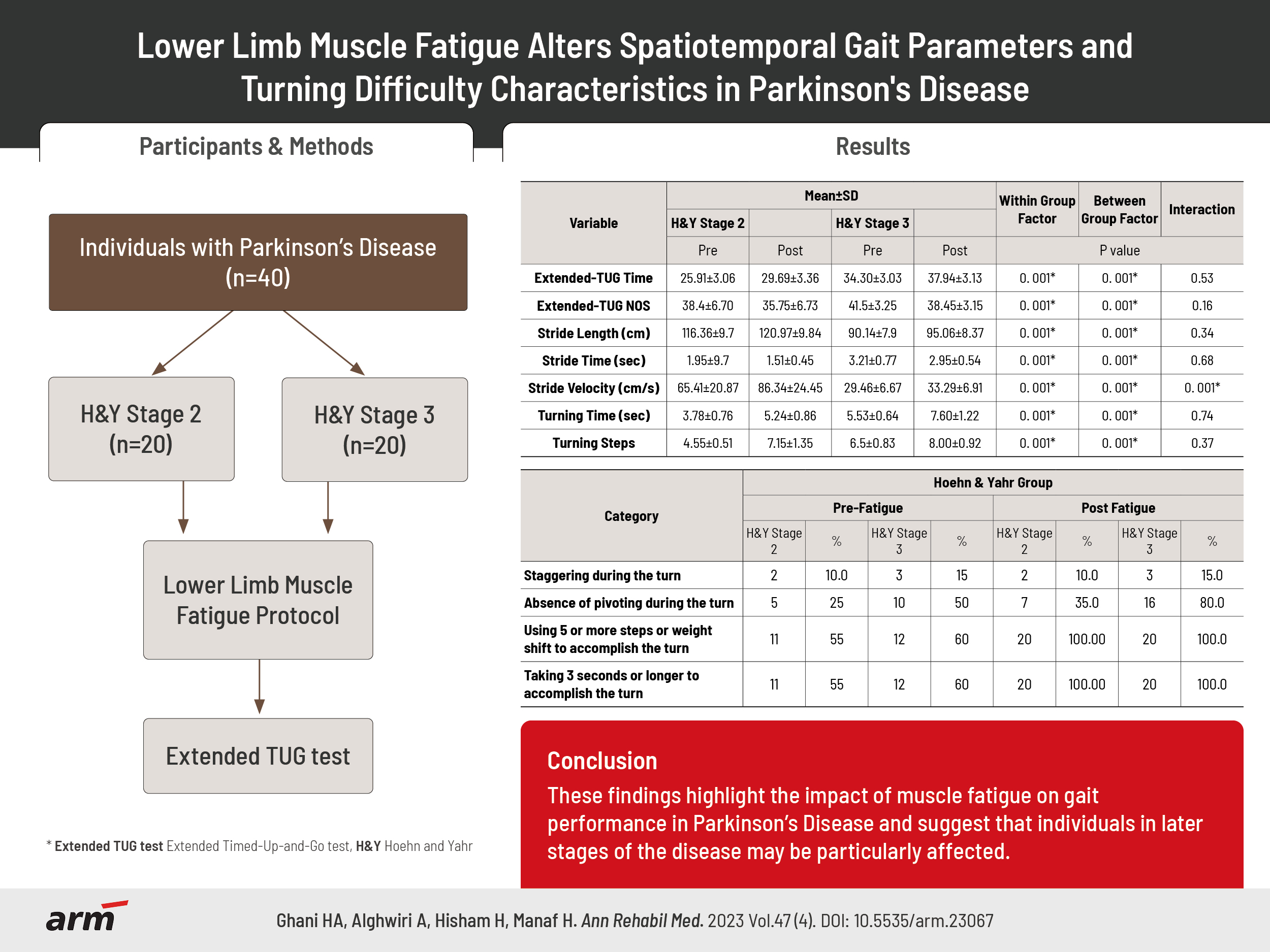
Objective To determine the effects of lower limb muscle fatigue on spatiotemporal gait parameters and turning difficulty characteristics during the extended Timed Up and Go (extended TUG) test in individuals with different severity stages of Parkinson’s disease (PD).
Methods Forty individuals with PD, classified as Hoehn and Yahr (H&Y) stages 2 and 3 participated in this pre- and post-experimental study design. The participants performed a continuous sit-to-stand task from a chair based on 30 cycles/min set-up to induce lower limb muscle fatigue. They performed extended TUG test immediately before and after completing the fatigue protocol. Spatiotemporal gait parameters and turning difficulty characteristics were recorded using two GoPro® Hero 4 Silver cameras. Data were subjected to a repeated-measure ANOVA.
Results Individuals with PD experience significant changes in spatiotemporal gait parameters, specifically stride velocity and length, under conditions of lower limb muscle fatigue (p=0.001). These changes were more pronounced in individuals with PD in the H&Y stage 3 group. Additionally, both PD groups exhibited difficulty with turning, requiring more than five steps to complete a 180° turn and taking more than 3 seconds to accomplish it.
Conclusion These findings highlight the impact of muscle fatigue on gait performance in PD and suggest that individuals in later stages of the disease may be particularly affected. Further research is needed to explore interventions that can mitigate these gait impairments and improve mobility in individuals with PD.
Citations
Citations to this article as recorded by
Fatigue‐Inducing Protocols in Parkinson’s Disease: Implications for Gait Assessment and Rehabilitation: A Systematic Review Mahdi Majlesi, Elaheh Azadian, Nader Farahpour, Rezvan Bakhtiarian, Hadi Nobari, Cristine Alves da Costa Parkinson's Disease.2026;[Epub] CrossRef
Negative Trend of Regularity of Locomotion in an Endurance Walking Task: Experimental Data from Healthy Adult Recreational Athletes in an Unsupervised 100 km March Marco Rabuffetti, Ilaria Carpinella, Stefan Mendt, Giampiero Merati, Mathias Steinach, Martina Anna Maggioni Applied Sciences.2026; 16(12): 6203. CrossRef
Comparison of stimulation sites enhancing dual-task performance using transcranial direct current stimulation in Parkinson’s disease Seo Jung Yun, Sung Eun Hyun, Woo Hyung Lee, Byung-Mo Oh, Han Gil Seo npj Parkinson's Disease.2025;[Epub] CrossRef
Better Understanding Rehabilitation of Motor Symptoms: Insights from the Use of Wearables Yunus Celik, Conor Wall, Jason Moore, Alan Godfrey Pragmatic and Observational Research.2025; Volume 16: 67. CrossRef
Association Between Turn Impairments and Cognitive Function in Parkinson Disease Shanhu Xu, Linlin Kong, Xiaoli Liu, Yue Lou, Luyan Gu, Qiuhan Xu, Xun Tan, Jiali Pu, Baorong Zhang AGING MEDICINE.2025; 8(4): 286. CrossRef



 First
 Prev


